Learn more about our API products here. Fill out the form below to get early access to our API products.
Webacy and Newton's VaultKit integration enables real-time stablecoin depeg monitoring and asset integrity checks, allowing onchain vaults and financial applications to enforce dynamic risk policies before transactions settle.
Webacy is building the ratings infrastructure for digital finance by providing continuous, independent risk ratings for stablecoins, RWAs, vaults, and digital assets, enabling institutions, regulators, and AI agents to assess on-chain asset integrity in real time.
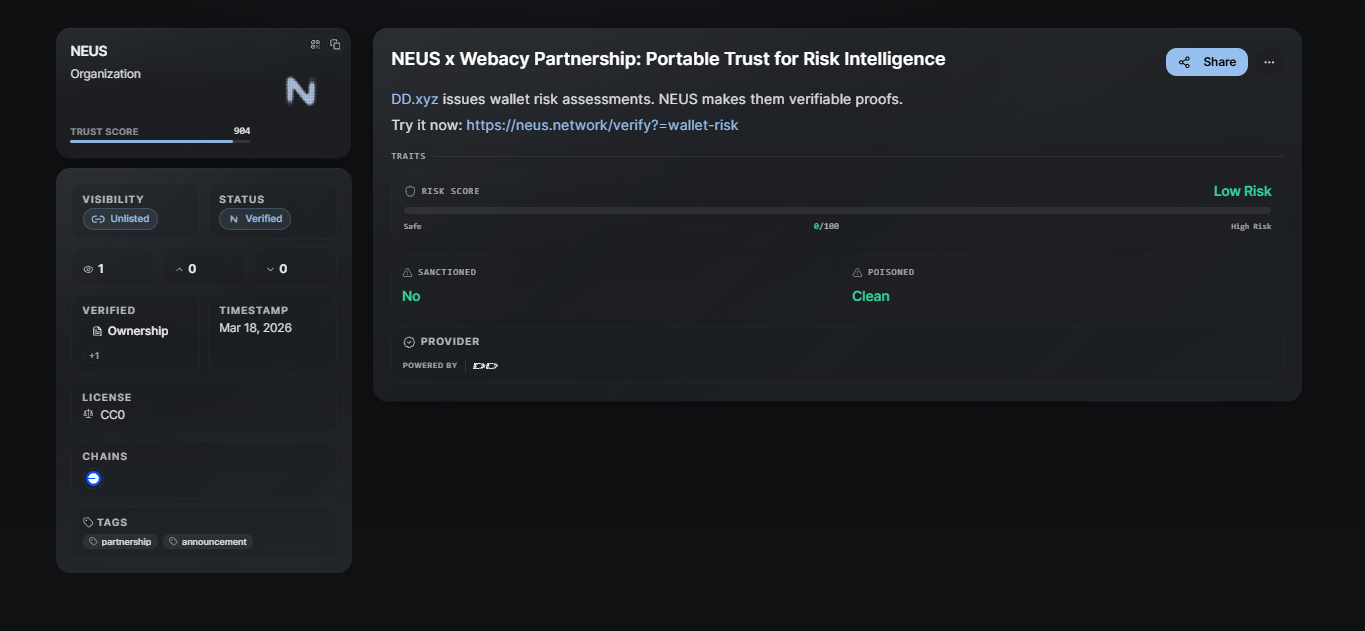
Webacy and NEUS introduce portable onchain trust infrastructure, enabling wallets, apps, and AI agents to share real-time risk assessments and verifiable trust receipts across the ecosystem instead of repeating fragmented security checks at every interaction.
Explore where DeFi vault yields come from through an analysis of $4.34 billion in Morpho vaults, examining lending interest, token incentives, shared market exposure, and liquidity risk.
Why a fully reserved stablecoin can still face redemption, banking, and payment-rail liquidity risk, and what issuers, institutions, and regulators should monitor in real time.
A proposed version of Section 302 outlined sanctions screening, transaction monitoring, and risk-based controls for onchain application layers, offering an early blueprint for how risk intelligence could become embedded directly into digital asset transactions.
A deep dive into the key questions institutions ask about stablecoin risk, including liquidity, redemption failure, governance, contamination exposure, and real-time monitoring for digital asset risk management.
The next generation of digital asset applications will not just read blockchain data, they will understand risk in real time through transaction safety, wallet intelligence, smart contract analysis, and continuous monitoring infrastructure built directly into the application layer.
Redemption risk is one of the most overlooked dangers in on-chain vaults, where high utilization, limited liquidity, and queued withdrawals can prevent investors from exiting when markets turn volatile.
As AI agents begin interacting directly with financial systems, one major problem is becoming increasingly obvious: AI does not natively understand digital asset risk.
April’s wave of DeFi exploits and stablecoin stress events revealed a harsh reality: AI-accelerated attackers are outpacing defenders, making real-time contagion monitoring, redemption risk analysis, governance surveillance, and digital asset risk intelligence essential infrastructure for institutional on-chain finance.
Explore how Mastercard and Circle are expanding stablecoin settlements and what it means for faster, lower-cost global payments.
The crypto stablecoin bill Senate vote (GENIUS Act) marks a major step toward regulating digital assets in the United States. It signals a shift toward clearer oversight as stablecoins become a core part of modern financial systems.
A guide to stablecoin risk outlining five critical domains: reserve backing, AML and sanctions, liquidity contagion, regulatory shifts, and continuous monitoring, that compliance teams must manage to meet evolving regulations and protect institutional exposure
Webacy’s analysis of crvUSD shows a resilient but structurally riskier crypto-backed stablecoin that maintains stability under normal conditions while remaining exposed to collateral volatility, liquidity concentration, and on-chain market dynamics.