The smart contract is audited. Collateral composition is reviewed and passes the checks. Manager and curator track record is legit. Most institutional due diligence stops there.
But there’s a large, looming risk that most don’t think about, until it’s too late. Redemption.
The Core Question: Can You Actually Get Out? Can you exit your position?
An on-chain vault can be structurally sound and still leave you unable to exit when you need to. Redemption risk is not about whether the vault is solvent. It's about whether your capital is accessible when you need it. Three numbers define this risk.
1. Utilization Rate
Utilization measures how much of the vault's total capital is actively deployed versus available in reserve. A vault with $500 million in assets and $450 million deployed is running at 90% utilization. The remaining 10%, or $50 million, is the buffer available for immediate withdrawals.
In normal market conditions, 10% may be adequate. Redemptions are distributed across a depositor base, and the vault handles them continuously.
In stress conditions, when multiple large depositors want to exit simultaneously, or when a market event drives coordinated outflows, that buffer disappears quickly. Borrowers don't repay loans on demand. The vault cannot instantly unwind deployed positions. What was a 10% buffer becomes a queue.
Utilization above 85% is a watch threshold. Sustained utilization above 90% means your effective exit capacity is constrained, and that constraint becomes binding in scenarios where you most want liquidity.
Utilization vs. Allocation: Two Different Numbers
These two metrics are related but measure different things, and conflating them leads to misjudging actual exit risk.
Allocation percentage tells you where the vault has deployed its capital across markets or strategies. A vault might allocate 98% of its assets to a single lending market and 2% to others. That's a concentration question: how diversified is the deployment?
Utilization tells you, within each of those markets, how much of the deposited capital is actively being borrowed versus sitting available. A market at 95% utilization has almost no idle capital sitting on the other side of your redemption request.
The two numbers compound. High allocation to a single market is a concentration risk. High utilization within that market means the capital locked there is not readily accessible. When both are elevated simultaneously, as in a vault that has 98% of assets in one market running at 90%+ utilization, your effective liquidity is a fraction of what the total TVL figure suggests. The vault is not in distress. It is simply fully deployed, and that has direct consequences for how quickly you can exit.
2. Liquidity Ratio and Position Sizing
The liquidity ratio tells you, in dollar terms, how much of the vault is available for immediate redemption at any given moment. This number changes continuously as capital flows in and out.
The practical implication for institutional allocators: your position size should be calibrated against the liquidity ratio, not against the total vault TVL. A $120 million immediate exit capacity means that positions above that threshold require queue-based redemption: you submit your request and wait for it to be processed as the vault unwinds positions or receives borrower repayments.
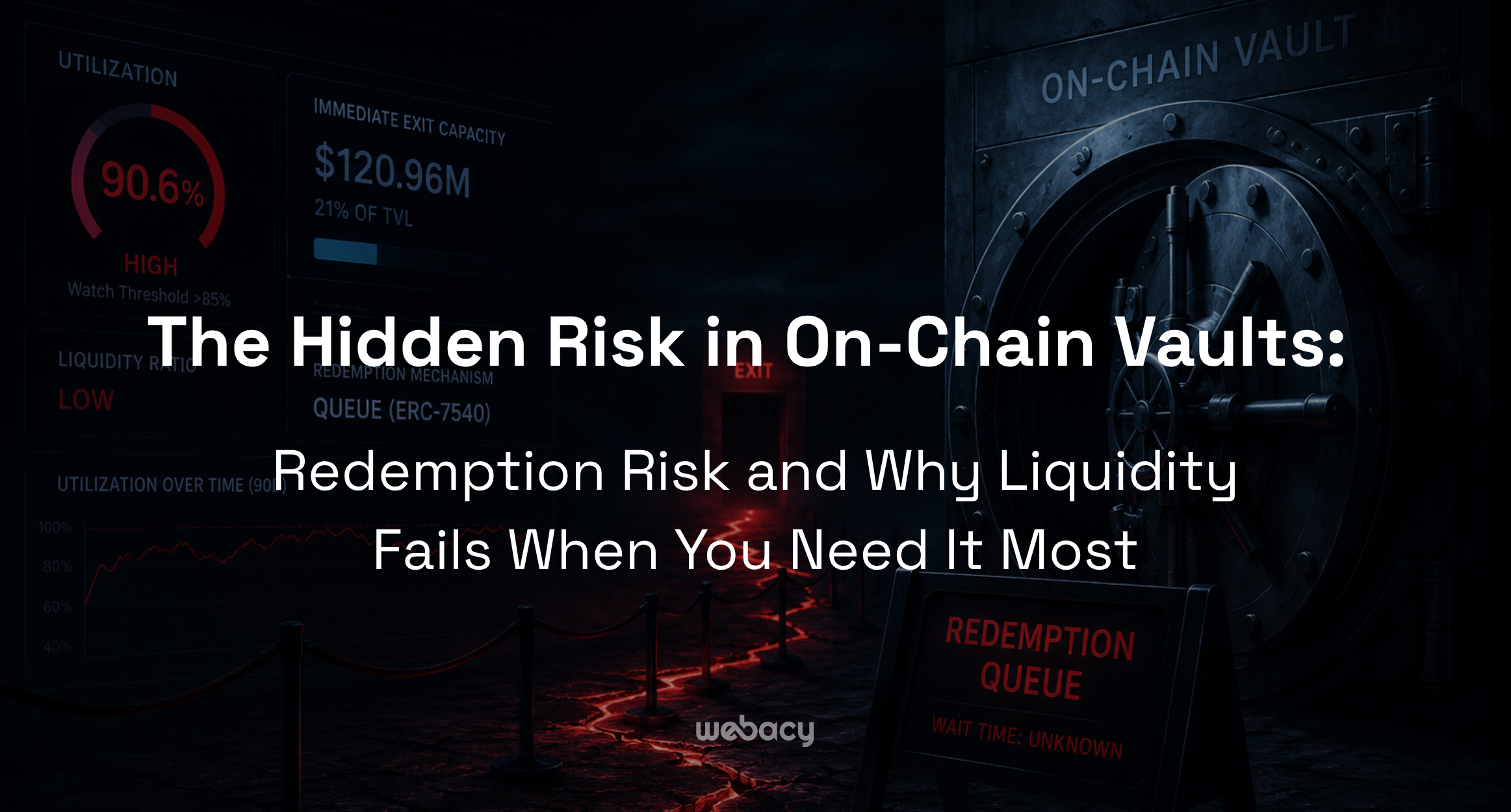
Steakhouse Prime USDC offers a concrete example. (At the time of drafting) TVL of $569.8 million. Utilization at 90.6%. Immediate exit capacity: $120.96 million, or about 21% of total assets. The five largest depositors together hold more than 95% of the vault. A coordinated exit by that group is a multi-day process, not a same-day transaction. The vault carries an A rating on DD.xyz, and that's accurate. But the liquidity structure is what determines whether you can execute your exit on your own timeline.
3. Redemption Mechanics: Instant vs. Queued
The technical structure of the vault determines how redemptions actually work.
Vaults built on ERC-4626, the more common standard, process redemptions synchronously. You submit a withdrawal request and receive your funds in the same transaction, subject to available liquidity. If the vault has the liquidity to cover your request, it settles immediately.
Vaults built on ERC-7540 use an asynchronous queue. You submit a redemption request. The vault processes it, which may involve unwinding positions, waiting for borrower repayments, or rebalancing allocations, and fulfills your request after that process completes. The timeline can range from hours to days depending on conditions.
Neither structure is inherently superior. Asynchronous redemption enables vaults to manage larger, less liquid strategies that would otherwise require maintaining larger idle buffers. But from an allocator's perspective, the mechanics determine your operational risk: ERC-4626 vaults give you transaction-level certainty on redemption; ERC-7540 vaults require you to model wait times into your liquidity planning.
Knowing which structure you are in before you allocate, not after, is the baseline.
The Three Questions to Ask Before entering any vault
1. What is the current utilization rate, and what has it averaged over the past 90 days?
2. What is the immediate exit capacity in dollar terms, relative to the position I am considering?
3. Does this vault process redemptions synchronously or through a queue?
These questions take minutes to answer with the right data. They determine whether your investment thesis holds in a stress scenario.
Do Your DD with DD.xyz
DD.xyz by Webacy serves real-time risk ratings and intelligence data for stables, vaults, and yield-bearing assets. Try it for yourself.