Learn more about our API products here. Fill out the form below to get early access to our API products.
Real-time stablecoin depeg monitoring that warns you before the price breaks and automates the audit trail for treasury, risk, and compliance teams. Suggested Slug: /blog/stablecoin-depeg-monitoring
VARA's latest guidance requires licensed VASPs in Dubai to review and document stablecoin, DeFi, and RWA risk every 90 days, creating a new need for continuous on-chain monitoring and evidence-based risk ratings.
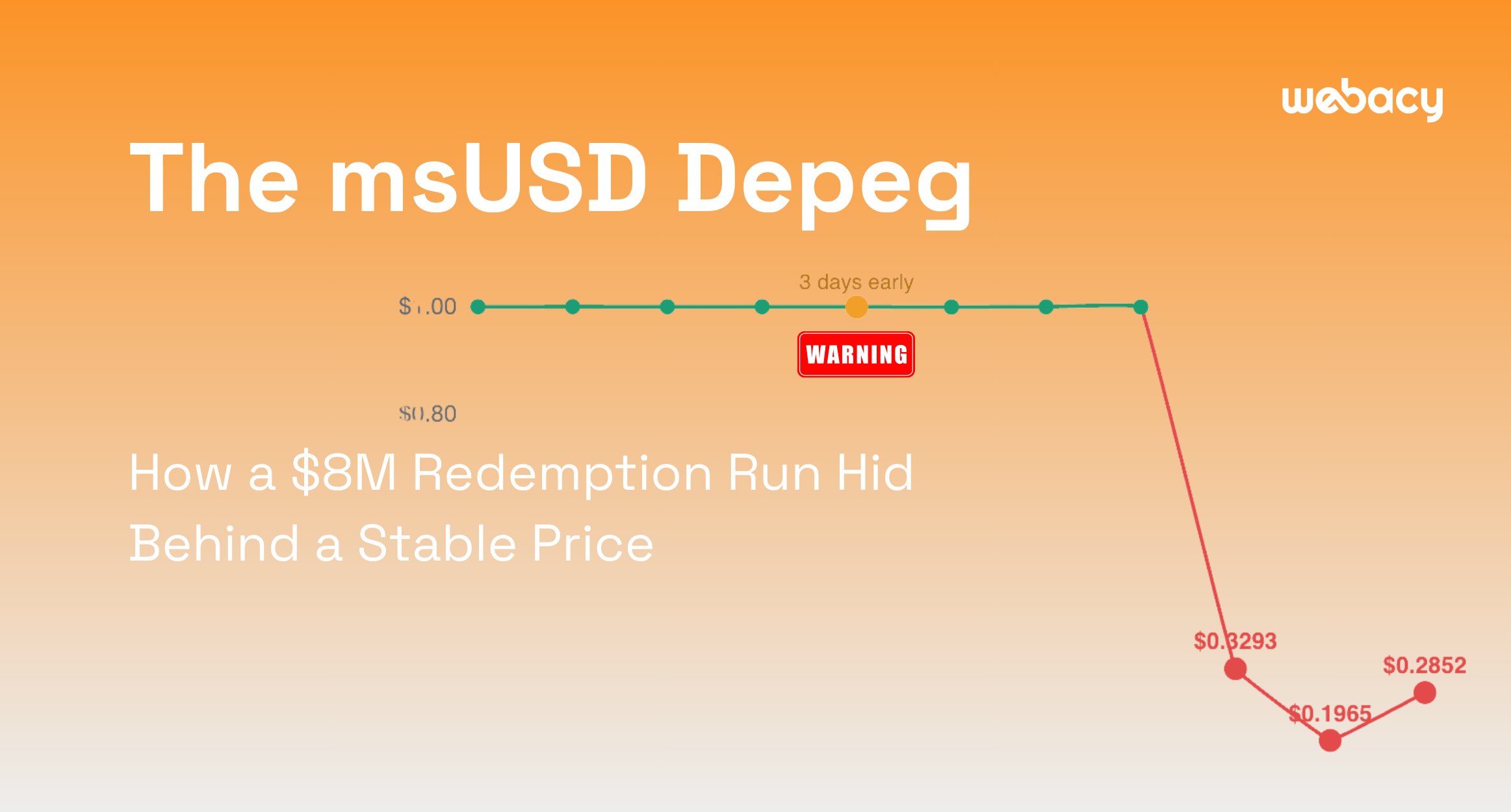
Two coordinated wallets redeemed roughly $8 million of msUSD at par in the five days before its 80% depeg, a redemption run that stayed completely invisible to price-based monitoring but was fully legible onchain through redemption-velocity and wallet-concentration analysis.
Explore where DeFi vault yields come from through an analysis of $4.34 billion in Morpho vaults, examining lending interest, token incentives, shared market exposure, and liquidity risk.
Why a fully reserved stablecoin can still face redemption, banking, and payment-rail liquidity risk, and what issuers, institutions, and regulators should monitor in real time.
A proposed version of Section 302 outlined sanctions screening, transaction monitoring, and risk-based controls for onchain application layers, offering an early blueprint for how risk intelligence could become embedded directly into digital asset transactions.
A guide to cryptocurrency address risk assessment tools — what they measure, where to find them, and how continuous ratings differ from basic wallet checkers.
Pre-sign transaction scanning evaluates blockchain transactions before execution. Learn why policy-aware infrastructure is now essential for compliance, AI agents, and institutional finance.
A practical guide to on-chain data and blockchain threat intelligence APIs — what each category covers, where gaps persist, and what institutional risk teams actually need.
A complete framework for evaluating stablecoin risk and on-chain asset integrity — peg mechanisms, reserve quality, smart contract exposure, and contamination risk.
Vault liquidity risk requires measuring utilization velocity, oracle integrity, redemption availability, and collateral contagion — not just audits. Here's the framework.
As the GENIUS Act and MiCA move from legislation to live enforcement, institutions holding or servicing tokenized assets face an expanding liability surface that KYC and AML frameworks were never designed to address — and the regulatory frameworks themselves now assume structural risk monitoring that most institutions don't have.
Digital asset ratings score vault, stablecoin, and smart contract risk using 20+ weighted sub-scores and real-time data. Here's the full methodology. Suggested Slug: /blog/how-digital-asset-ratings-work
The Webacy CLI gives developers, security teams, and AI agents real-time digital asset risk intelligence directly in the terminal, enabling wallet screening, smart contract due diligence, transaction safety checks, sanctions monitoring, and multichain asset analysis through automation-ready command line workflows.
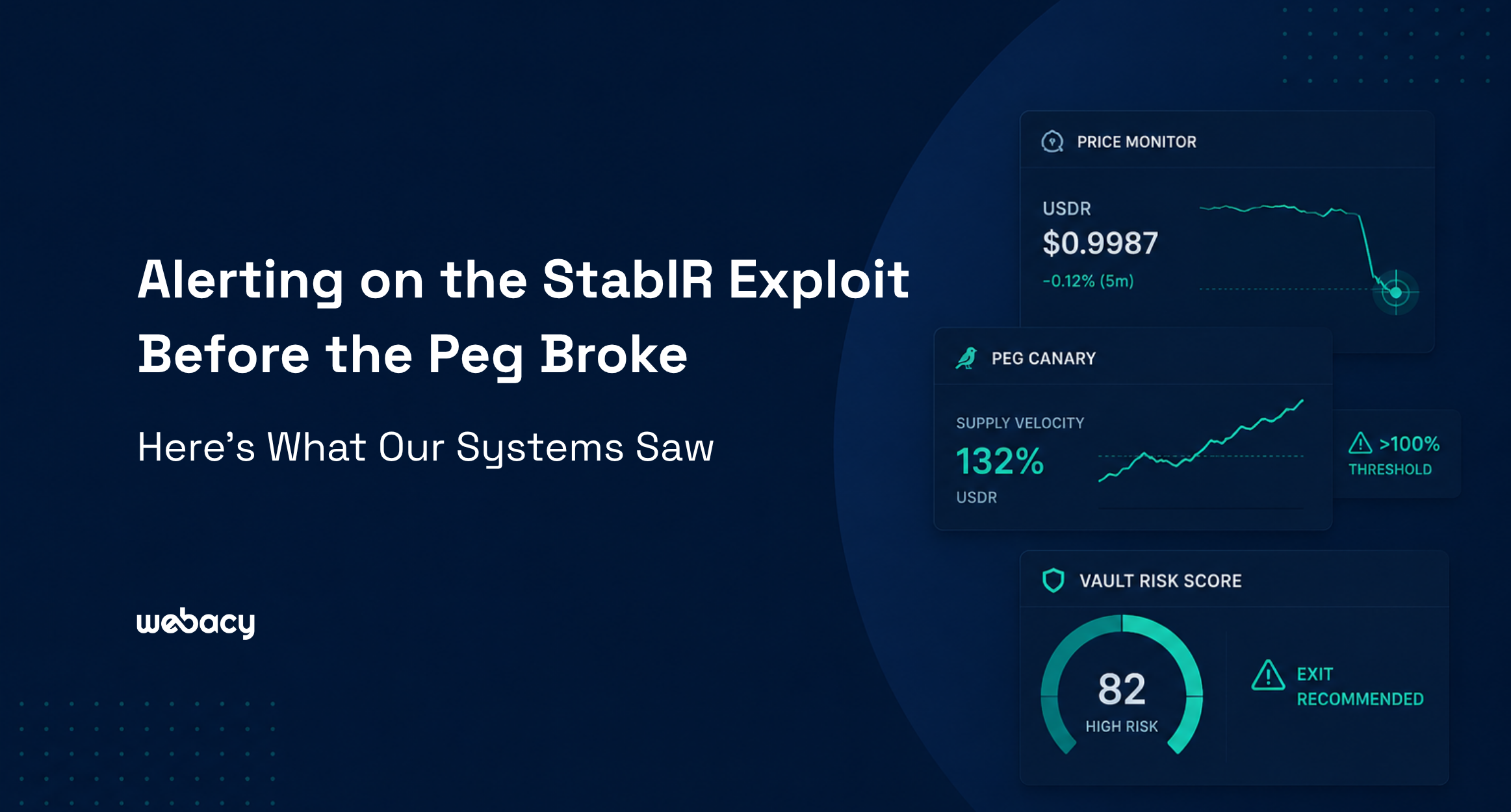
Webacy's real-time stablecoin monitoring systems detected the $13.5M StablR exploit, flagging anomalous supply velocity and price deviation signals before the peg broke, continuing a track record that includes catching the Resolv USR depeg 2 hours and 17 minutes before the official announcement.