Learn more about our API products here. Fill out the form below to get early access to our API products.
DD AI is Webacy’s agent-forward onchain risk intelligence platform, giving people, businesses, and AI agents instant access to live asset, wallet, transaction, and protocol analysis through chat, MCP, APIs, and x402 payments.
Webacy is partnering with CertiK to enhance vulnerability triage, surface high-quality security findings, and strengthen its defense-in-depth cybersecurity strategy.
Agent payment stacks verify identity, authority, and counterparties. None verify the stablecoin itself. Inside the asset-integrity gap in agentic payments.
Wallet guardrails control what an AI agent can do, not whether the asset is safe. Why agentic payments need a real-time asset risk layer.
A research post-mortem of Main Street Finance's June 2026 collapse — and why the design, not the trigger, is the story.
A guide to cryptocurrency address risk assessment tools — what they measure, where to find them, and how continuous ratings differ from basic wallet checkers.
Pre-sign transaction scanning evaluates blockchain transactions before execution. Learn why policy-aware infrastructure is now essential for compliance, AI agents, and institutional finance.
A practical guide to on-chain data and blockchain threat intelligence APIs — what each category covers, where gaps persist, and what institutional risk teams actually need.
A complete framework for evaluating stablecoin risk and on-chain asset integrity — peg mechanisms, reserve quality, smart contract exposure, and contamination risk.
Vault liquidity risk requires measuring utilization velocity, oracle integrity, redemption availability, and collateral contagion — not just audits. Here's the framework.
As the GENIUS Act and MiCA move from legislation to live enforcement, institutions holding or servicing tokenized assets face an expanding liability surface that KYC and AML frameworks were never designed to address — and the regulatory frameworks themselves now assume structural risk monitoring that most institutions don't have.
Digital asset ratings score vault, stablecoin, and smart contract risk using 20+ weighted sub-scores and real-time data. Here's the full methodology. Suggested Slug: /blog/how-digital-asset-ratings-work
The Webacy CLI gives developers, security teams, and AI agents real-time digital asset risk intelligence directly in the terminal, enabling wallet screening, smart contract due diligence, transaction safety checks, sanctions monitoring, and multichain asset analysis through automation-ready command line workflows.
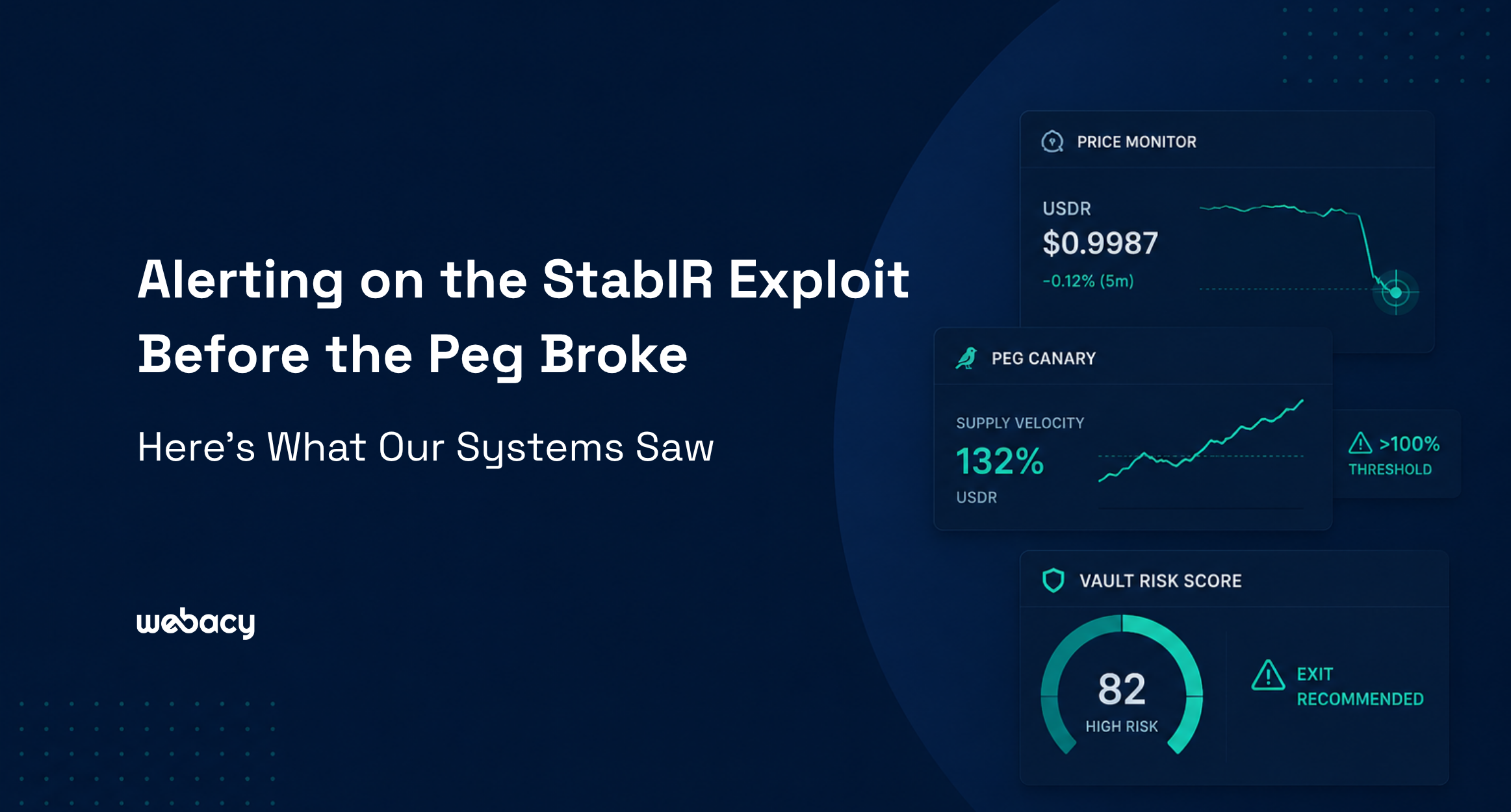
Webacy's real-time stablecoin monitoring systems detected the $13.5M StablR exploit, flagging anomalous supply velocity and price deviation signals before the peg broke, continuing a track record that includes catching the Resolv USR depeg 2 hours and 17 minutes before the official announcement.