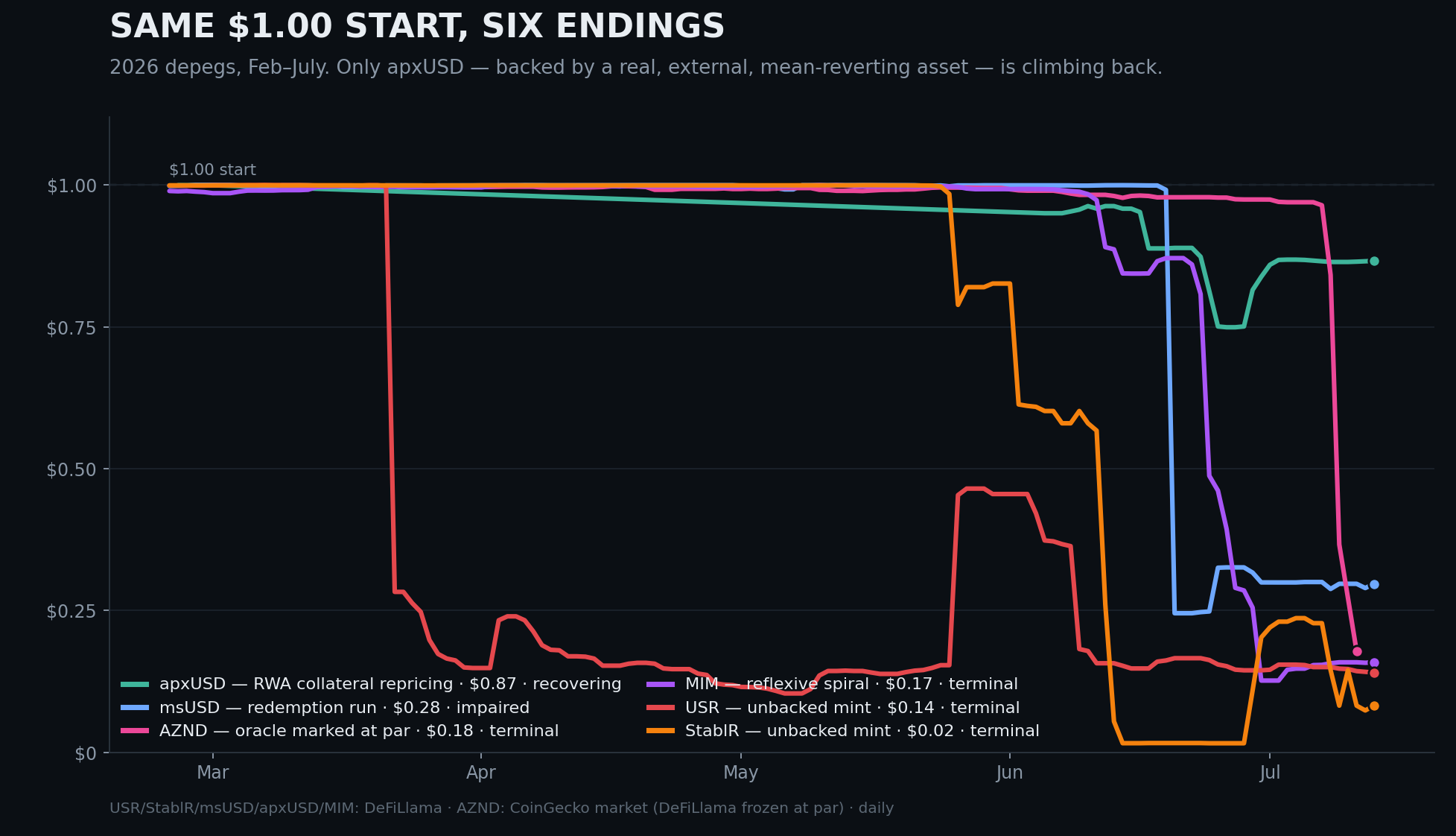
The stablecoin graveyard is bigger than most people track: 36 stablecoins have collapsed with measurable loss since 2022, destroying $2.5 billion in value, and 2026 alone has added six. Step back and look at the whole of 2026 so far, and a more uncomfortable pattern emerges than any single incident tells: the failure mechanism, not the size of the break, determines whether holders recover anything at all.
With our monitoring of 600+ tokens across eight EVM chains plus a growing Solana set. Here is what those systems saw in 2026:
- USR (March) and StablR (May) were unbacked mints. Not smart-contract bugs, but administrative failures: a minting key behind a nominal "multisig" with a threshold of one. StablR is the sharpest version. A single compromised key minted both 8.35M USDR and 4.5M EURR, and the issuer's entire stablecoin line depegged within hours.
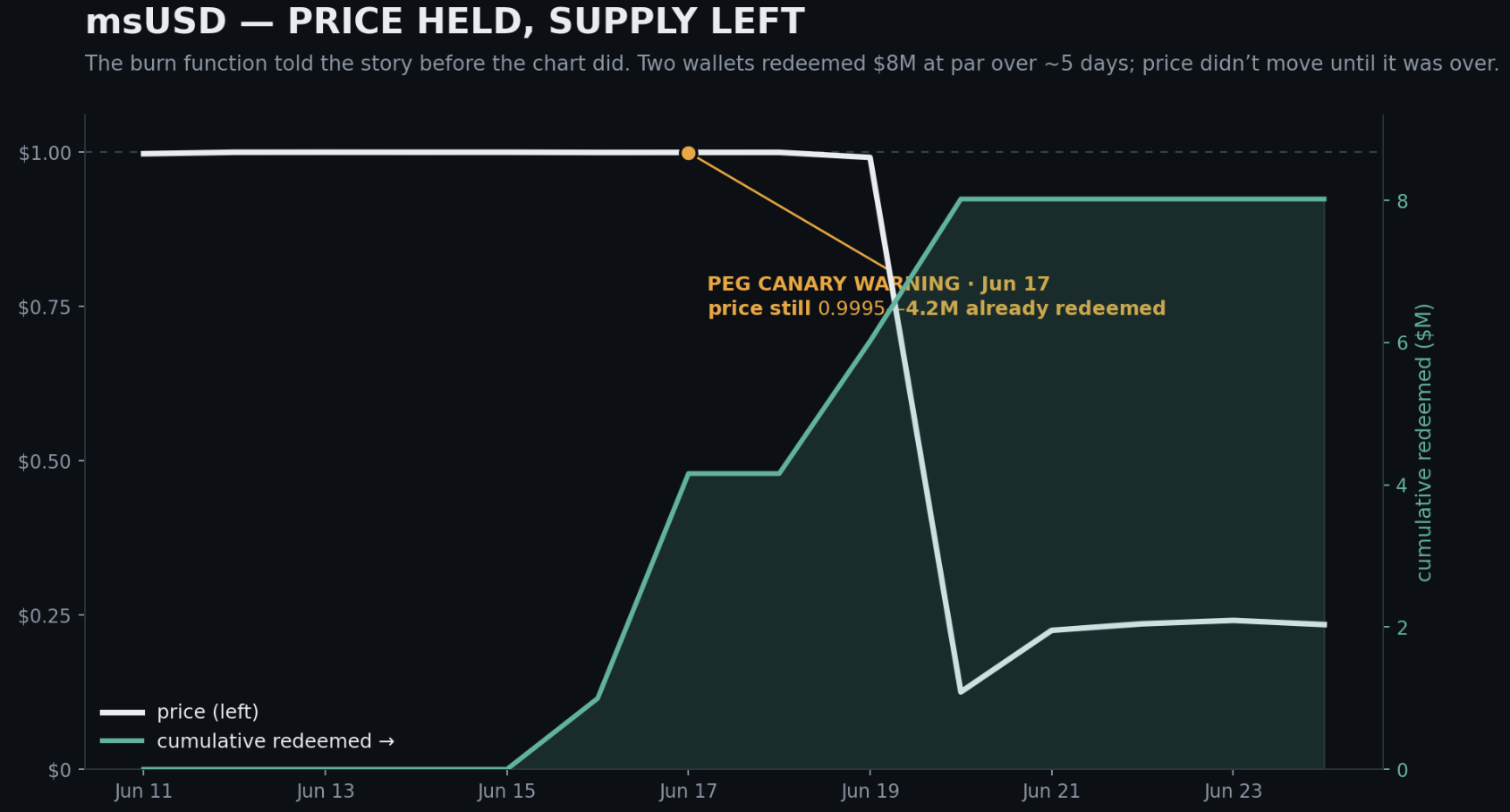
- msUSD (June) was a redemption run. The price held at exactly $1.00 for five days while two wallets quietly redeemed $8M at par and left. We saw a signal in the burn function, not the order book. The chart moved last.
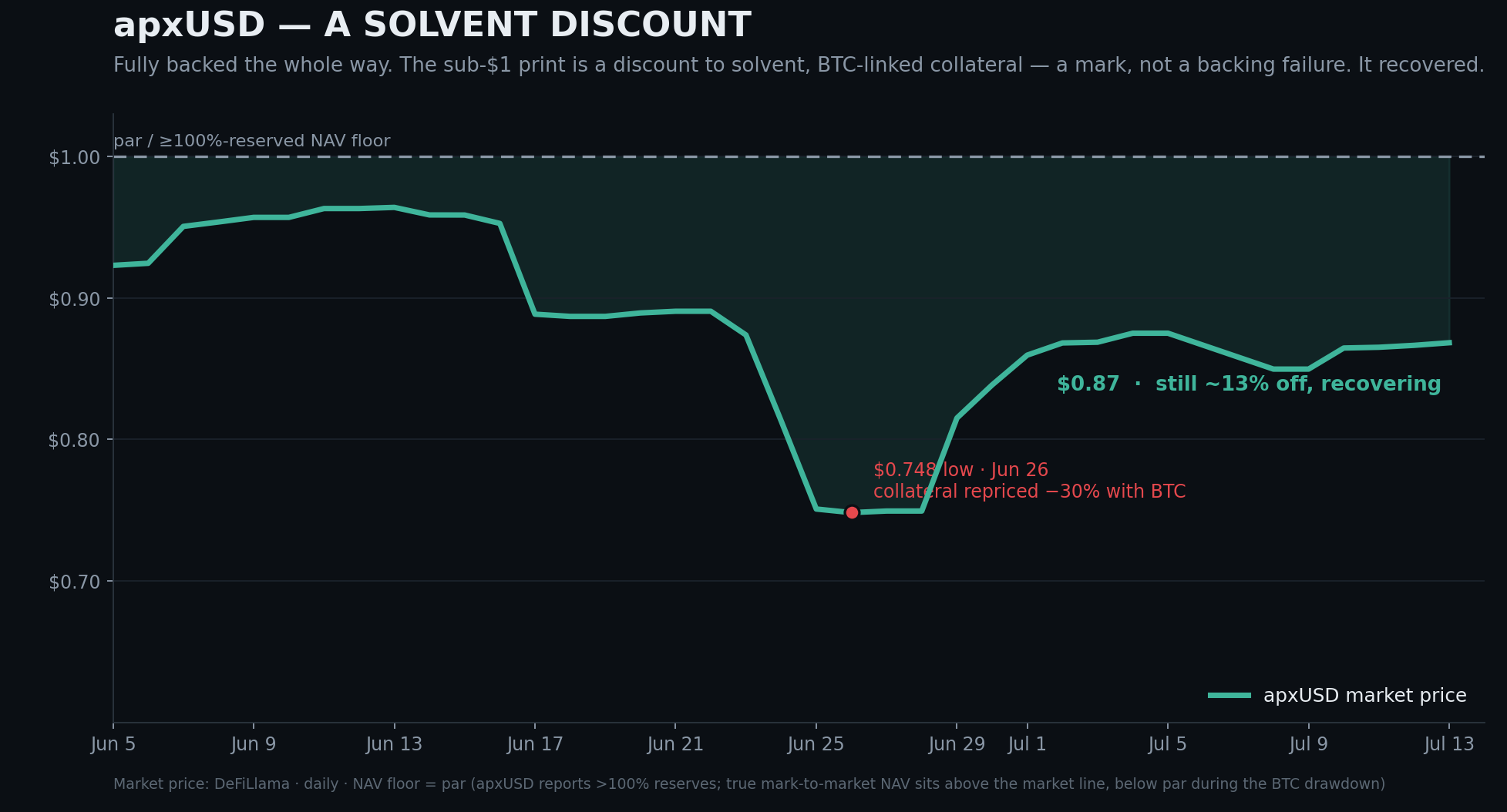
- apxUSD (June) was a solvent collateral repricing. Its reserves, Strategy's STRC preferred shares and indirectly a Bitcoin proxy, repriced through a −30% BTC drawdown, so the token traded to $0.74 while staying fully backed. A sub-dollar print here is a mark, not a failure.
- MIM (June) was the one everyone thought was extinct: a reflexive collateral spiral. Abracadabra's stablecoin eroded through mid-June, cliffed on the 25th, and kept falling to $0.09. The UST-class death spiral didn't die in 2022. It just put on a crypto-collateral wrapper.
- AZND (July) was the one the price feed itself couldn’t see. Mu Digital’s tokenized Asian-credit stablecoin still printed $0.9998 on DeFillama while the market had already repriced it to $0.18. The break wasn’t in the mint, the burn, or the book; it was in the mark. When Mu Digital’s reserve verifier was deprecated and its lending oracle froze at par, an address deposited AZND as collateral into a Morpho market and borrowed the real USDC straight out, draining the vault to 100% utilization and 0% yield. It “held peg” on every oracle-priced surface the entire way down.
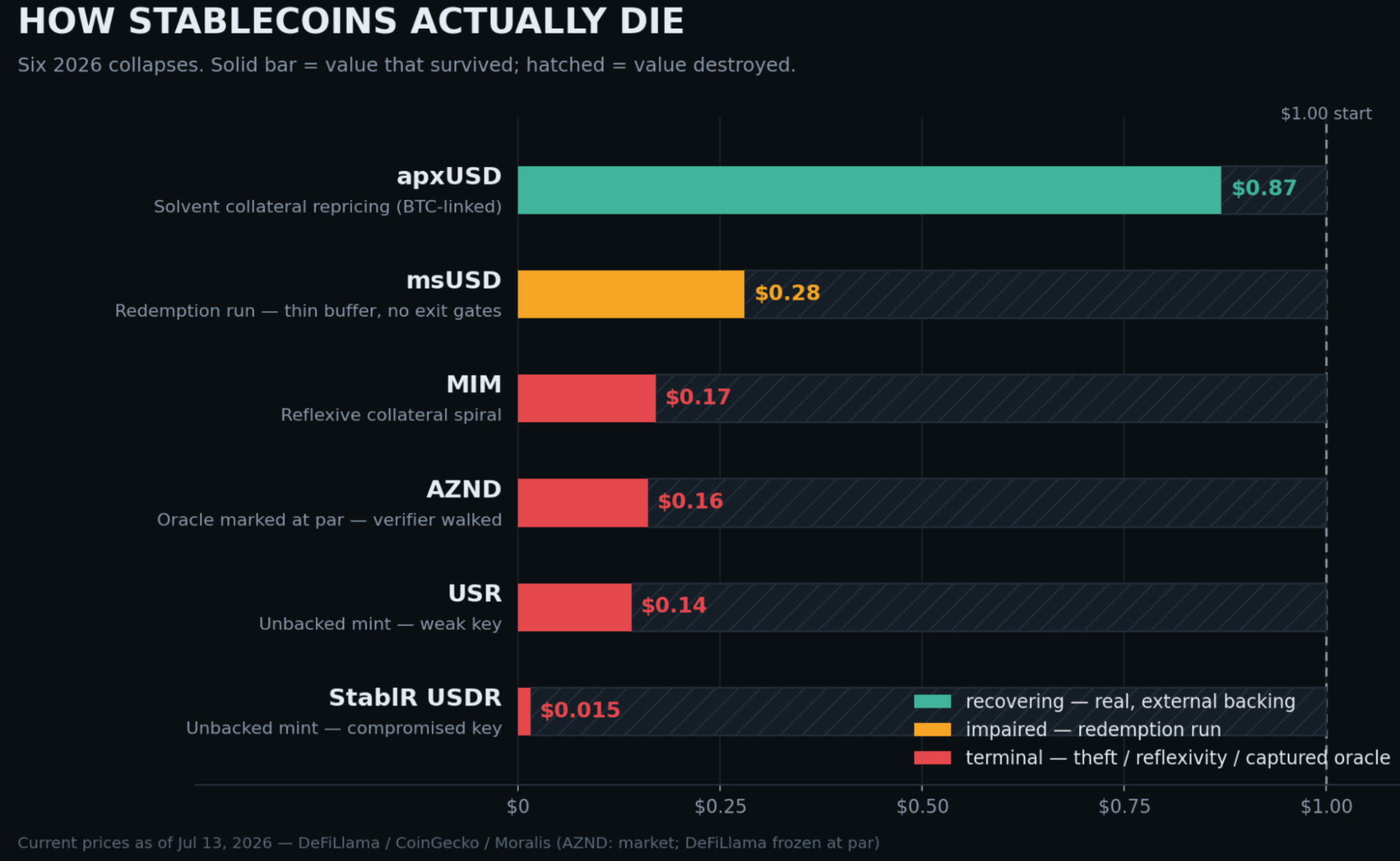
Multiple stablecoin depegging, multiple causes. This should shape how everyone in the industry needs to think about this: The failure mechanism didn't just decide how they broke, it also influenced whether they recover. Four months on, the two unbacked mints, the reflexive spiral, and AZND (whose verifier walked and whose issuer is now in an orderly wind-down) are all still near zero. Theft, reflexivity, and a stale oracle are terminal. The redemption run is impaired but alive around $0.28. The only one climbing back is apxUSD, because its backing was a real, external, mean-reverting asset that recovered.
Line the six up by what actually backs them and you can see the pattern. The single predictor of recovery is not the size of the break, it is whether the backing was real and external.

None of that is legible in a price feed until it's over. A stablecoin can be minting from an exploit, bleeding supply through a quiet redemption, trading at a discount to a perfectly solvent NAV, or sitting on a DEX book so thin that a $10,000 sell moves the peg, and a monitor that only watches "how far from $1" learns about every one of these last. Depegging is the result, not the cause.
This quarter we shipped the improved infrastructure to ensure the coverage of all types of attacks: our Peg Canary System got some upgrades, a pre-depeg stress engine that reads supply, liquidity, governance, and exit signals before price confirms anything, and propagates those reads up into vault grades and recommendations. Six live events. Six different failure modes. The same system caught all of them.
Capturing Signal for Each Kind of Break
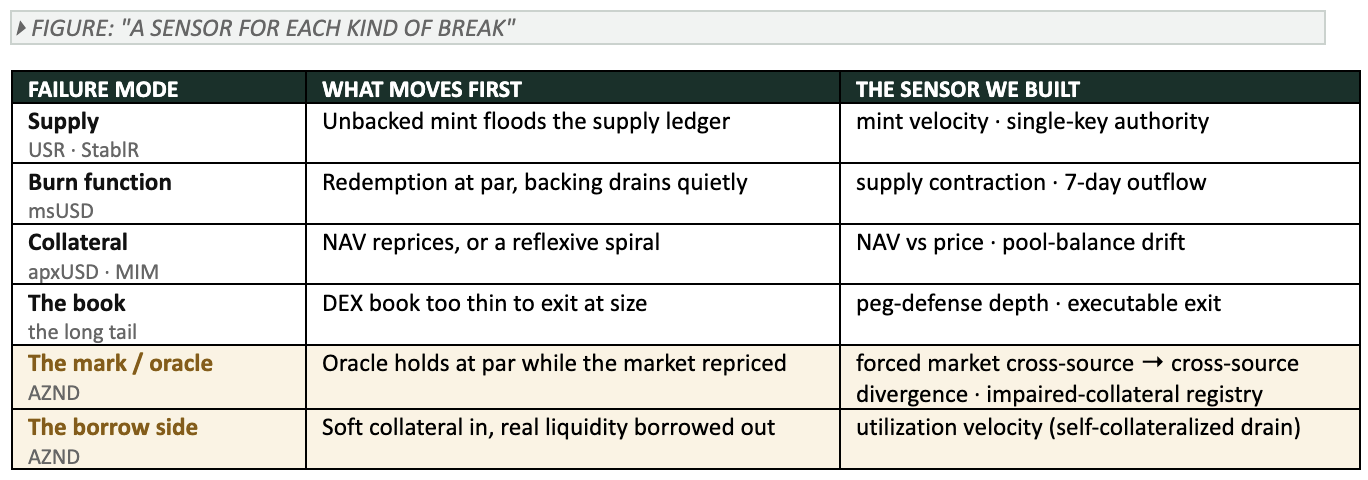
The incidents above share one thing and differ in one thing. What they share: price was the last thing to move. What separates them: which signal moved first. A monitor that only watches dollar deviation sees a single number; we built a different sensor for each way a peg actually breaks, so that when the number arrives, it arrives with a reason attached.
When supply moves first (USR, StablR). An unauthorized mint as a result of weak keys governance floods unbacked tokens into the market, and price follows supply. Our mint-velocity, single-key mint-authority, and mint-spike-without-backing signals were built for this class. StablR sharpened the governance side: its "multisig" was a 1-of-3 wallet with a threshold of one, where a Safe-only check would have returned nothing. Our resolver reads the actual owner structure, so governance is incorporated into our global composite score.
When the burn function moves first (msUSD). A few wallets redeemed ~$8M at par while the price sat flat, so the supply contracted before the chart did. Concentrated redemptions are the signal, and they are measurable on-chain regardless of intent. We built redemption-velocity detection, then extended it into a supply-contraction lens (cumulative seven-day outflow) that catches the slow bleed a 24-hour mint detector never will. This system raised a warning on msUSD on June 17, three days before the cliff, while the daily price still read $0.9995. You can read an even deeper technical analysis here.
When the collateral moves first (apxUSD, MIM). Sometimes the token is tracking what it is backed with, not failing on its own. apxUSD’s reserves repriced with Bitcoin and the token followed it down, staying solvent the entire way. MIM’s collateral spiraled reflexively and never came back. "Off peg versus $1" and "off peg versus NAV" are different questions, and conflating them produces either false alarms or false comfort. Our structural-health layer prices collateral-backed stables against their attested NAV where we have it, and it separates a solvent NAV discount from an unbacked mint.
When the book moves first (the long tail). A thin DEX book breaks on a small sell, so price leads with no supply or collateral signal to warn you. That failure mode gets its own sensors: peg-defense depth, executable exit, and the liquidity-to-supply ratio.
When the mark moves first, or never (AZND). Sometimes the reference price is the failure. An RWA or NAV token can be marked at par by a frozen or captured oracle while the market has already moved. That is book value by construction. AZND read $0.9998, confidence 1.0, on one of the primary oracles while it traded to $0.18. A monitor that trusts its main feed sees nothing; cross-source divergence only fires if you force a second, market-based read. So for oracle-priced tokens we resolve a live market price alongside the aggregator and drop the at-par oracle from the consensus, which turns a ~1.4 price spread into the signal instead of silently trusting the mark. And because a captured oracle can hold at par indefinitely, we back the read with a price-independent impaired-collateral registry: a vault holding a known-impaired token floors regardless of what the oracle says.
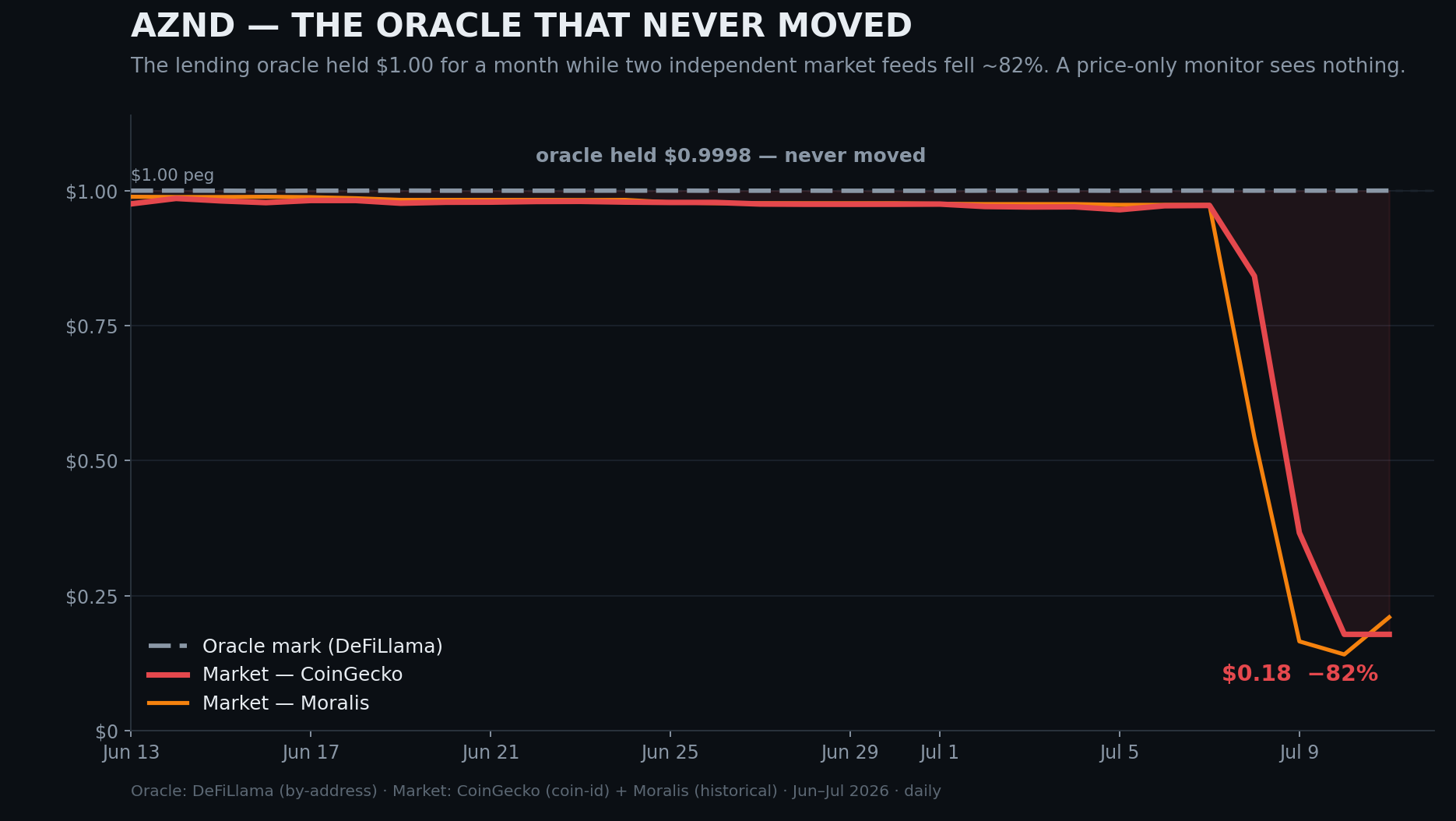
When the borrow side moves first (AZND, again). The exit here wasn’t a mint or a redemption. It was a loan. Deposit a soft, oracle-inflated token as collateral, borrow the real liquidity, and leave the lenders holding the mark. We catch it as utilization velocity on a market whose collateral is impaired, the borrow-side mirror of the unbacked mint, flagged while the vault is still draining rather than after it locks.

None of these shows up as a single number on a price chart. Each one needs its own sensor.
PCS: From Canary to Composite
PEG CANARY started narrow: supply velocity, one threshold but has evolved into an 18-signal composite (0–100) built to fire before price confirms, across four families: flow/supply (mint velocity, bank-run gauge, TVL-supply divergence, unbacked-mint spikes, the new 7-day supply-contraction signal); liquidity (DEX-float-to-supply, erosion, plus peg-defense depth, executable exit, deviation persistence); market integrity (cross-source divergence, source confidence, freeze activity); and governance (single-key mint authority, whale concentration). Missing signals skip and the rest renormalize.
From Stablecoin to Vault: Collateral Liquidity Propagation
The vault rating inherits stablecoin stress in real time. This quarter we added visibility into fragility short of a depeg: the Euler case (a vault holds a $1.00 stablecoin it can't sell at size) and the AZND case (a vault holds a token still marked at par while the market has left). Every vault on a monitored stablecoin now carries its peg-defense cost, DEX depth, and exit capacity, plus two hard floors from AZND: a price-independent impaired-collateral floor, and a util-locked-distressed floor that flips a 100%-utilized, zero-yield vault to critical even when its oracle says $1.
Governance as Structure, Not Just Events
March's USR post covered single-key mint detection. May's StablR post showed why that isn't enough: when the "multisig" is a 1-of-3 wallet that doesn't speak the Safe ABI, an owner() check learns nothing. So we split governance into two layers:
Structure is who owns the contract today: EOA versus Safe versus timelock, M-of-N depth, and whether the upgrade admin can swap the implementation. An operational EOA owner is centralized ops; an EOA on the upgrade path is a rug vector.
Events are what's happened recently: MINTER_ROLE grants and revocations, proxy upgrades, ownership transfers, pause cycles. The structure enricher classifies every token as strong, adequate, weak, critical, or unknown.
Memory: Graveyard and Depeg History
Detection without memory is just alerting. Two additions this quarter make the system's history queryable: a Stablecoins Graveyard (curated metadata on collapsed tokens, their peak value, failure cause, and timeline) and Depeg History (per asset, a historical record of depegs associated with the token).
What Actually Kills Stablecoins
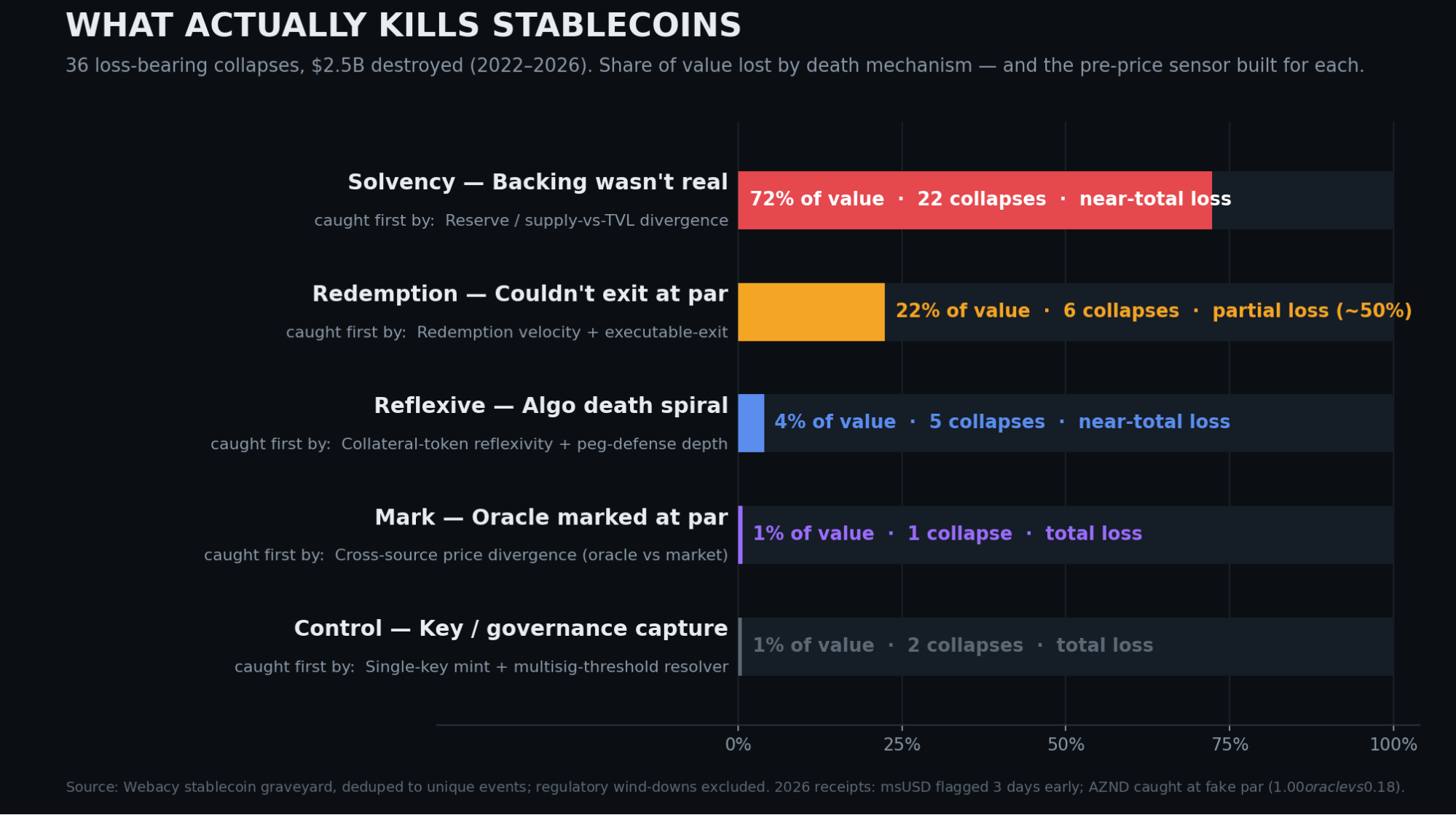
A graveyard isn't only a memorial, it's an important historical dataset. Ours holds 36 loss-bearing collapses worth $2.5B of destroyed value (2022–2026, orderly regulatory wind-downs excluded). Read it by failure mechanism rather than by name, and one lesson dominates everything else.
The biggest killer is that the backing was never real. Solvency failures (an unbacked or fraudulent mint, or a reserve that was really a claim on a counterparty who failed) account for 72% of all value destroyed and the majority of events, and they are near-total: holders recover almost nothing. It is the biggest killer by dollars and by frequency at the same time. Everything a peg-risk grade does should start here.
The failure everyone underwrites against is the smallest one. Reflexive "algorithmic death spirals," the Terra-shaped fear, are 4% of the damage in our set, near-last. The number-two killer is redemption failure (couldn't exit at par) at 22%, and notably it is the survivable one: a median ~50% loss, not a wipeout. Solvency takes everything; a redemption break takes half. For a financial reader those are different questions, and the mechanism is what tells them apart.
This is the empirical case for how we weight the grade: collateral quality and exit liquidity dominate the score because they are what actually kill stablecoins, not audit checklists or issuer history. Every class in the chart maps to a sensor built to fire before price confirms the break, and the taxonomy is still growing: AZND's oracle-marked-at-par failure mode is some of the latest. Most of all, the graveyard stops being just what the system remembers and becomes ground truth what we test the grade against.
The Bottom Line
Every depeg in 2026 told us the same thing in different flavors: by the time the price confirms a break, the money that was paying attention has already left. USR and StablR left through the mint function. AZND left through the borrow function while the oracle held the door shut at $1.00. apxUSD never left at all, because nothing was actually broken, only repriced. Different exits, one shared truth. Price is the receipt, not the warning.
So we stopped building better receipts. The second layer reads the supply ledger, the liquidity book, the governance surface, the exit mechanics, and, after AZND, the mark itself. It scores the stress before the price confirms it and carries that read all the way up into vault grades, so the answer is the same whether you ask about a stablecoin or the vault holding it. When an alert fires now, it arrives with a mechanism and a reason attached. Not just a number.
That is the infrastructure we set out to build this quarter, and it is what our partners are asking for. Not "tell me when it breaks." Tell me what is breaking, how long I have, and whether I can still get out at size.
If that is the question your risk desk is asking, we built the answer. The system is live at dd.xyz or reach out directly to talk about what continuous structural ratings would look like for your portfolio.