Learn more about our API products here. Fill out the form below to get early access to our API products.
Webacy and Newton's VaultKit integration enables real-time stablecoin depeg monitoring and asset integrity checks, allowing onchain vaults and financial applications to enforce dynamic risk policies before transactions settle.
Webacy is building the ratings infrastructure for digital finance by providing continuous, independent risk ratings for stablecoins, RWAs, vaults, and digital assets, enabling institutions, regulators, and AI agents to assess on-chain asset integrity in real time.
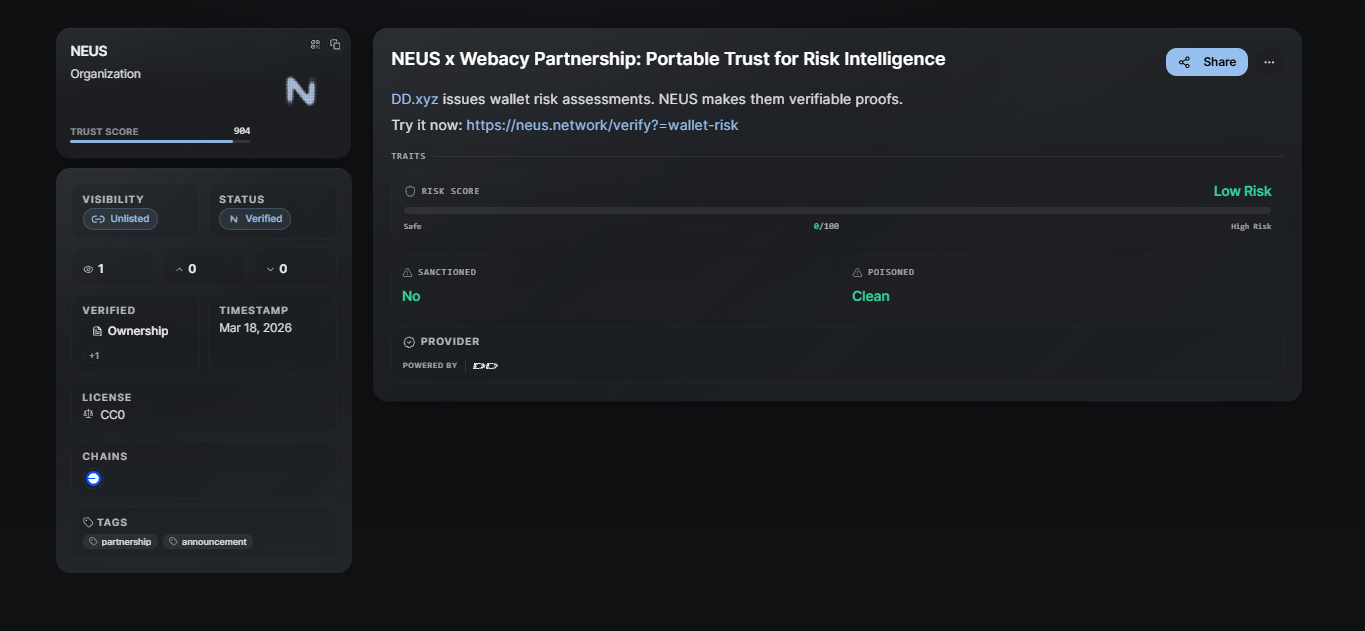
Webacy and NEUS introduce portable onchain trust infrastructure, enabling wallets, apps, and AI agents to share real-time risk assessments and verifiable trust receipts across the ecosystem instead of repeating fragmented security checks at every interaction.
Explore where DeFi vault yields come from through an analysis of $4.34 billion in Morpho vaults, examining lending interest, token incentives, shared market exposure, and liquidity risk.
Why a fully reserved stablecoin can still face redemption, banking, and payment-rail liquidity risk, and what issuers, institutions, and regulators should monitor in real time.
A proposed version of Section 302 outlined sanctions screening, transaction monitoring, and risk-based controls for onchain application layers, offering an early blueprint for how risk intelligence could become embedded directly into digital asset transactions.
Agentic payment and asset-management systems have built a control layer to govern what AI agents are authorized to do, but they still lack a risk layer to tell them whether the stablecoins, vaults, and counterparties they're settling into are actually safe at the moment of execution.
S&P and Moody's brought ratings onchain, but they're still periodic, issuer-informed opinions. Here's what that misses about what actually happens onchain.
Agent payment stacks verify identity, authority, and counterparties. None verify the stablecoin itself. Inside the asset-integrity gap in agentic payments.
Wallet guardrails control what an AI agent can do, not whether the asset is safe. Why agentic payments need a real-time asset risk layer.
A CTO's H1 recap dissecting six 2026 stablecoin collapses to show that the failure mechanism — not the size of the depeg — determines whether holders recover, and how Webacy built a dedicated pre-price sensor for each way a peg breaks.
Real-time stablecoin depeg monitoring that warns you before the price breaks and automates the audit trail for treasury, risk, and compliance teams. Suggested Slug: /blog/stablecoin-depeg-monitoring
A research post-mortem of Main Street Finance's June 2026 collapse — and why the design, not the trigger, is the story.
Vault curator due diligence in 10 questions. What to ask about recursive leverage, exit liquidity, oracles, and conflicts before deploying capital.
Liquidity risk in DeFi is the danger that a token can't be bought or sold without severe price impact, or can't be exited at all, driven by onchain conditions like thin pools, unlocked LP tokens, and concentrated ownership that can change in a single transaction.