Learn more about our API products here. Fill out the form below to get early access to our API products.
Real-time stablecoin depeg monitoring that warns you before the price breaks and automates the audit trail for treasury, risk, and compliance teams. Suggested Slug: /blog/stablecoin-depeg-monitoring
VARA's latest guidance requires licensed VASPs in Dubai to review and document stablecoin, DeFi, and RWA risk every 90 days, creating a new need for continuous on-chain monitoring and evidence-based risk ratings.
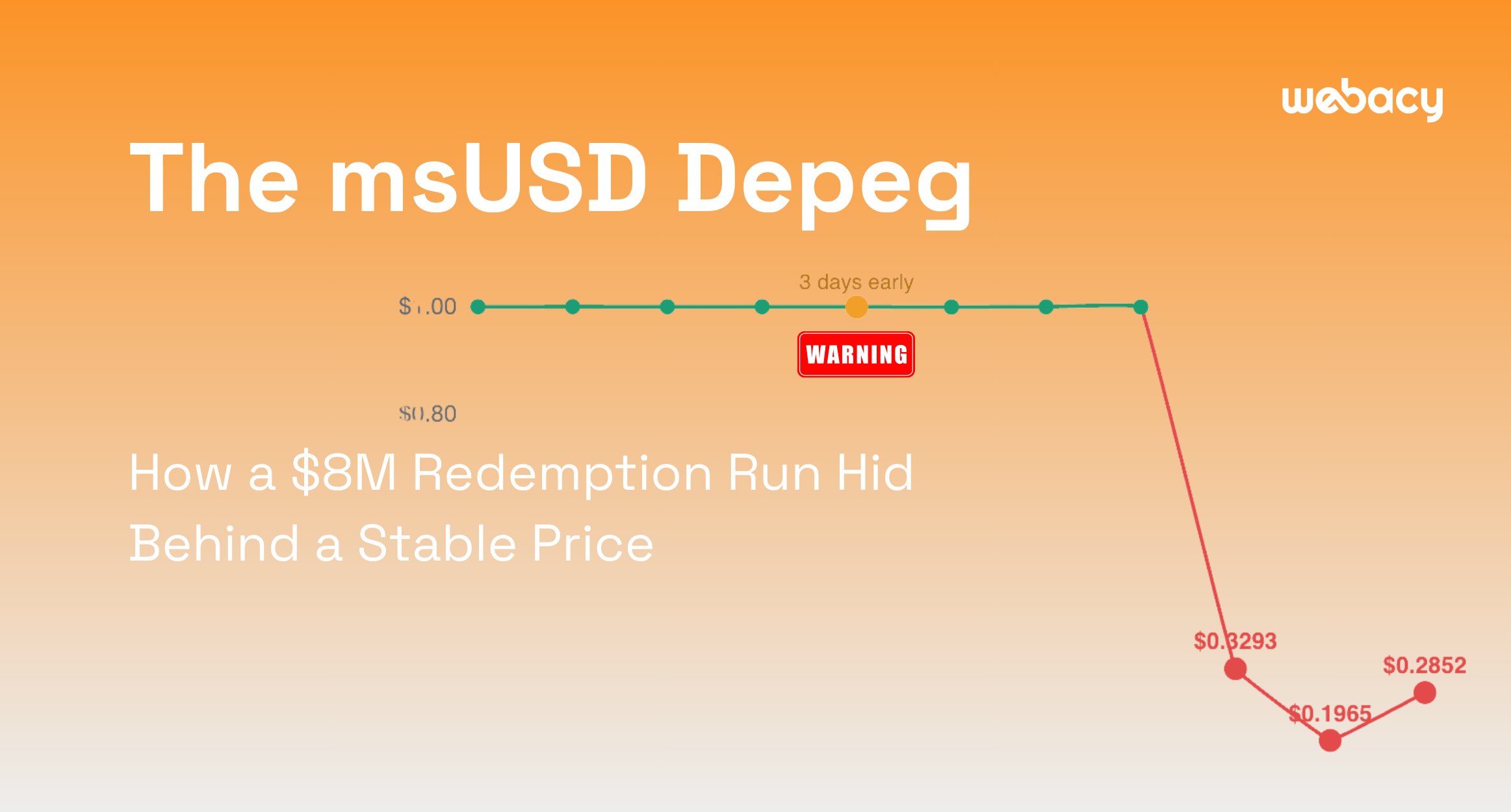
Two coordinated wallets redeemed roughly $8 million of msUSD at par in the five days before its 80% depeg, a redemption run that stayed completely invisible to price-based monitoring but was fully legible onchain through redemption-velocity and wallet-concentration analysis.
The Webacy CLI gives developers, security teams, and AI agents real-time digital asset risk intelligence directly in the terminal, enabling wallet screening, smart contract due diligence, transaction safety checks, sanctions monitoring, and multichain asset analysis through automation-ready command line workflows.
A deep dive into the key questions institutions ask about stablecoin risk, including liquidity, redemption failure, governance, contamination exposure, and real-time monitoring for digital asset risk management.
The next generation of digital asset applications will not just read blockchain data, they will understand risk in real time through transaction safety, wallet intelligence, smart contract analysis, and continuous monitoring infrastructure built directly into the application layer.
Explore where DeFi vault yields come from through an analysis of $4.34 billion in Morpho vaults, examining lending interest, token incentives, shared market exposure, and liquidity risk.
DD AI is Webacy’s agent-forward onchain risk intelligence platform, giving people, businesses, and AI agents instant access to live asset, wallet, transaction, and protocol analysis through chat, MCP, APIs, and x402 payments.
Why a fully reserved stablecoin can still face redemption, banking, and payment-rail liquidity risk, and what issuers, institutions, and regulators should monitor in real time.
A proposed version of Section 302 outlined sanctions screening, transaction monitoring, and risk-based controls for onchain application layers, offering an early blueprint for how risk intelligence could become embedded directly into digital asset transactions.
What the reUSD liquidations on Morpho teach us about leverage, liquidity and better onchain risk controls
Webacy is partnering with CertiK to enhance vulnerability triage, surface high-quality security findings, and strengthen its defense-in-depth cybersecurity strategy.
Webacy Achieves SOC 2 Compliance, Strengthening Its Commitment to Security, Trust, and Protection of Customer Data Through Independent Third-Party Validation.
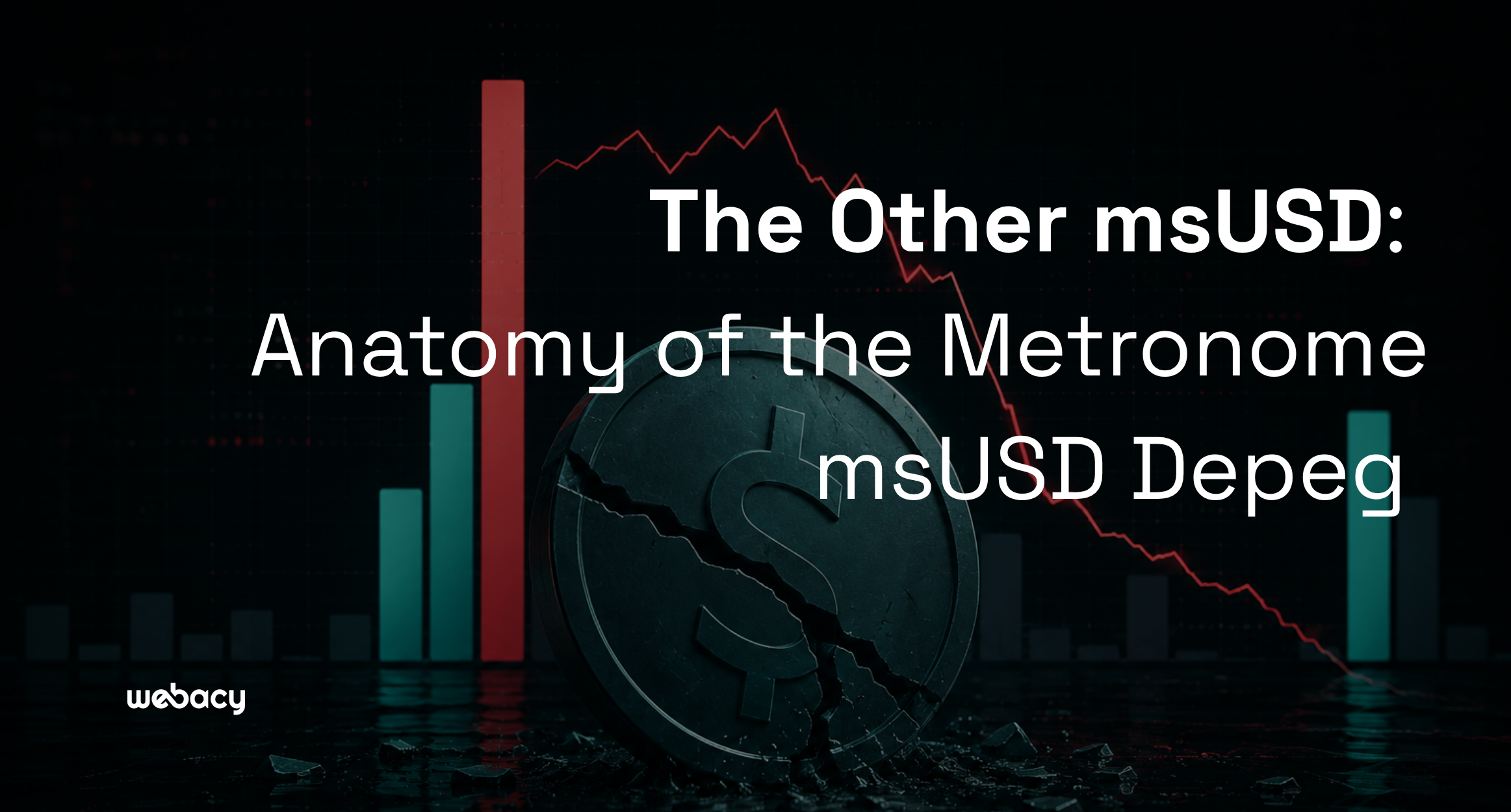
A deep dive into how Metronome's msUSD lost its peg, and how on-chain supply expansion, stale oracle pricing, and structural risk signals exposed the depeg long before the market did.