You can hold a token whose price looks perfectly healthy and still be unable to sell a single dollar of it. That gap, between what a token is worth on paper and what you can actually exit at, is liquidity risk. It's one of the least understood and most expensive risks in onchain finance, and it rarely announces itself before it costs someone money.
TL;DR
- Liquidity risk is the danger that you can't buy or sell a token without moving its price against you, or can't exit at all.
- It comes in four main forms: insufficient liquidity, unlocked liquidity, fake liquidity, and concentrated liquidity.
- Low liquidity multiplies slippage: on a $10k pool, a $10,000 trade can eat 50% or more in price impact.
- Unlocked LP tokens are the single most common mechanism behind rug pulls, and liquidity locking promises were broken in roughly 45% of rug-pull cases over the past year.
- The dangerous conditions are onchain and observable, but they can flip in one transaction, which is why point-in-time checks miss them.
- Continuous monitoring of pool depth, lock status, and LP concentration is the only way to catch a liquidity event while there's still time to act.
What Is Liquidity Risk in DeFi?
Liquidity risk in DeFi is the risk tied to a token's tradability: the ability to buy or sell without significantly impacting the price. When liquidity is low, unlocked, or manipulated, that ability degrades fast, and the consequences range from painful slippage to funds that are effectively frozen.
Four things make liquidity matter.
1. Price impact, because thin pools mean large trades swing the price.
2. Exit ability, because you need someone on the other side of the trade to sell into.
3. Rug pull risk, because unlocked liquidity can be removed instantly.
4. And market manipulation, because shallow markets are cheap to push around.
For a retail trader, this shows up as a bad fill. For a treasury desk, an exchange evaluating a listing, or an RWA platform accepting a token as collateral, it shows up as a position that can't be unwound at the mark. The mechanics are identical. Only the size of the loss changes.
The Four Ways Liquidity Turns Against You
Liquidity risk is not one problem. It's a family of related failure modes, and a token can carry more than one at once.
Insufficient liquidity. There simply isn't enough capital in the trading pool to support meaningful volume. Large trades cause extreme slippage, and exiting a sizable position may be impossible without crashing the price yourself.
Unlocked liquidity. The LP (liquidity provider) tokens that represent a pool's deposits are not locked in a timelock contract. That means the owner can withdraw the entire pool at any moment. This is the primary mechanism behind rug pulls, and it's the difference between a project that can drain you and one that can't.
Fake liquidity. Liquidity is added to create the appearance of a deep, safe market, then removed. Often it's paired with wash trading to manufacture volume. The pool looks tradable right up until you try to trade it.
Concentrated liquidity. A handful of wallets control most of the pool. Even if the liquidity is technically present, it represents a single point of failure: those wallets can pull out in coordination and collapse the market in one move.
Slippage: Why Low Liquidity Multiplies Your Losses
Slippage is the difference between the price you expect and the price you actually get. In thin markets it stops being a rounding error and becomes the whole trade. The relationship between pool depth and price impact is brutal and non-linear.
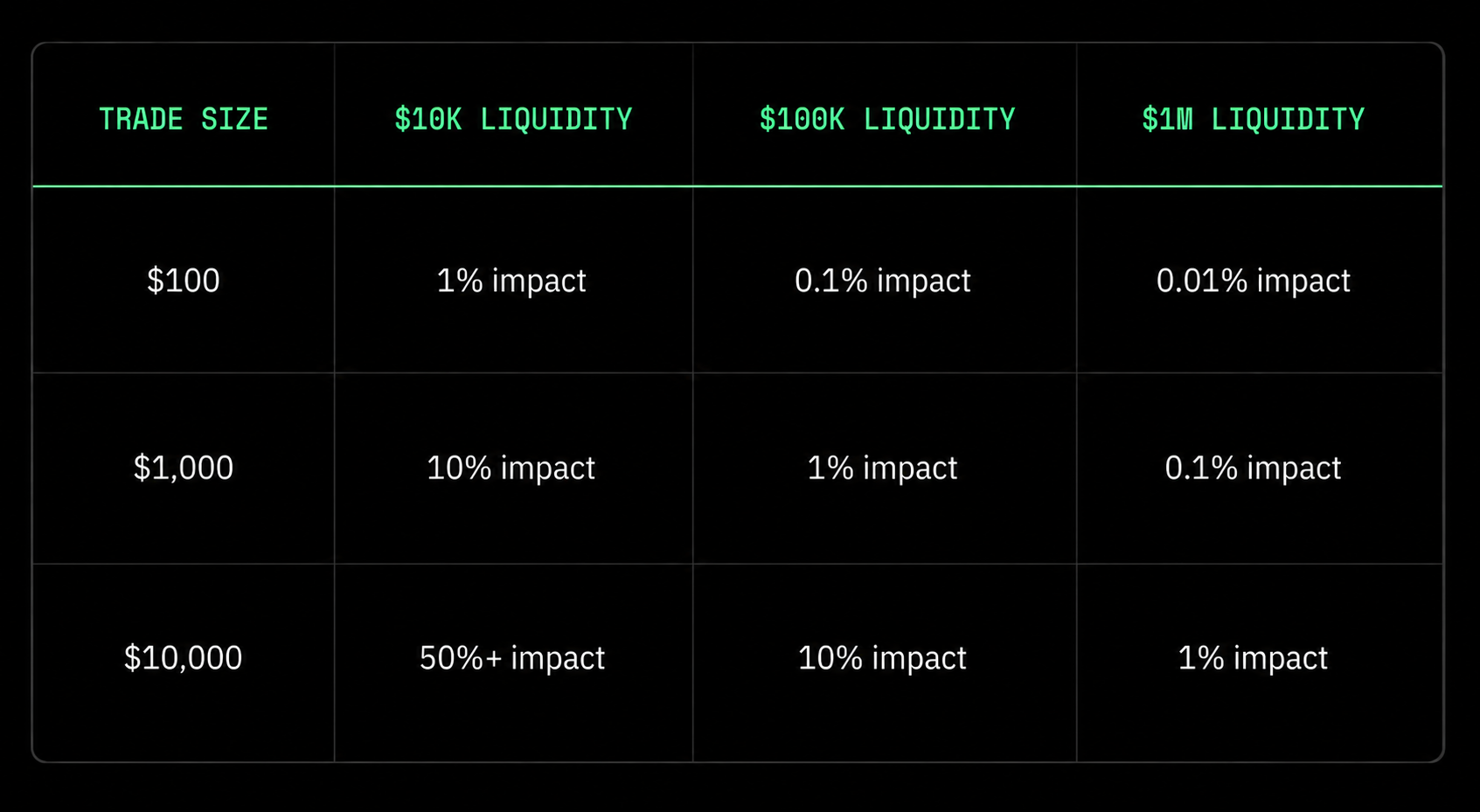
Note: This is an approximation. Actual price impact depends on the AMM curve (e.g. Uniswap v2/v3), concentrated liquidity distribution, order book depth, and fees.
Read the bottom-left cell carefully. On a $10k pool, trying to move $10,000 can cost you half your position to price impact alone, before any malicious behavior enters the picture. The same trade against a $1M pool costs about 1%. This is why total liquidity is the first number to check, and why a token can be a fine buy at small size and a trap at scale.
The Red Flags That Precede a Liquidity Event
Most liquidity disasters are legible in advance if you're watching the right onchain signals. These are the detection indicators (on DD.xyz and Webacy APIs) that flag elevated liquidity risk before it becomes a loss.
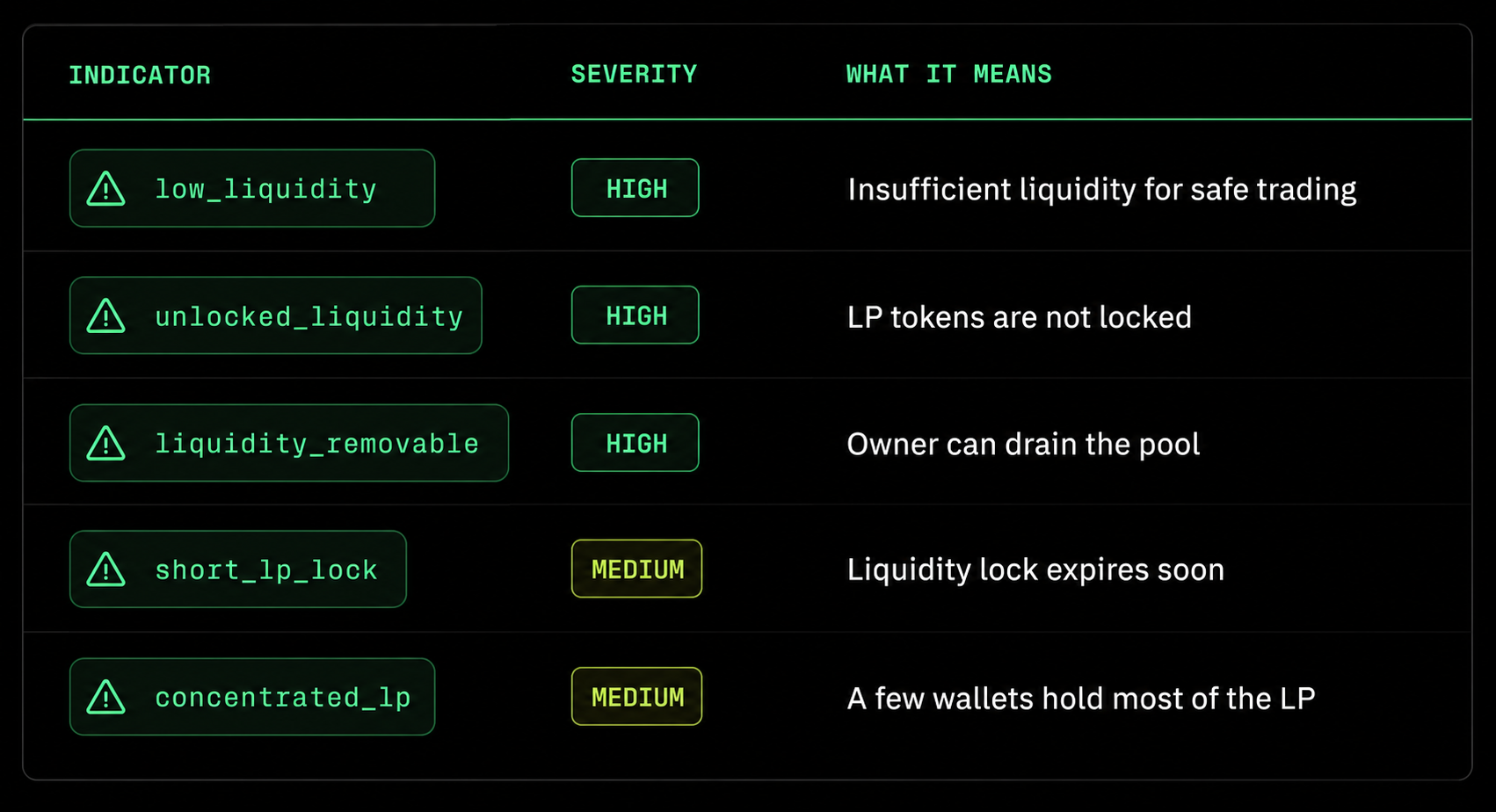
Beyond the discrete flags, a few patterns deserve constant attention. Liquidity under $10,000 signals very high slippage risk. A lock that's expiring soon turns a safe token into a countdown. An unknown lock contract may have backdoors, so the identity of the locker matters as much as the lock itself. And declining liquidity often means insiders are quietly exiting ahead of everyone else.
A proper liquidity lock has four properties worth verifying: a reputable lock contract, a duration of at least six months and ideally over a year, a majority of the LP actually locked (80% or more), and onchain verifiability rather than a claim in a Telegram channel.
Why Point-in-Time Checks Fail
Here's the part that trips up even careful teams. Every one of the conditions above is a snapshot. You can check a token today, confirm the liquidity is deep, the LP is locked for a year, and the holders are distributed, and be completely correct. Then the lock expires next Tuesday, the owner pulls the pool, and your clean report is worthless.
The industry data makes the point. Liquidity locking promises were broken in roughly 45% of rug-pull cases over the past year, and soft rug pulls, where teams drain liquidity gradually rather than all at once, rose sharply between 2024 and 2025. A typical pattern is a token that launches with liquidity locked for seven days, grows to a healthy pool over the following week, and gets drained in a single transaction on day eight. The lock did exactly what it promised. The token still went to zero.
This is the structural problem: liquidity risk is dynamic, but most due diligence is static. A one-time check tells you the state of the pool at the instant you looked, not whether that state holds tomorrow. By the time a quarterly report or a manual re-check catches a drained pool, the exit window has already closed. Liquidity, once it leaves, does not wait for anyone to notice.
What Continuous Monitoring Changes
This is the problem Webacy was built to solve. Webacy is an institutional risk infrastructure provider that turns onchain conditions into continuous, explainable risk signals. Rather than treating a risk assessment as a report you pull once, Webacy watches the underlying conditions and pushes an alert the moment they change.
The same indicators covered in this article, low liquidity, unlocked or removable LP, expiring locks, and concentrated ownership, are the exact conditions Webacy's systems monitor, detect, and alert on. Instead of polling a token and hoping you checked at the right time, you subscribe to a risk-tier change event and get a signed notification the moment a token crosses a threshold. A lock nearing expiration, a pool that starts declining, an owner who suddenly gains the ability to remove liquidity: these become alerts, not surprises you discover after the fact.
The difference is the same one that separates a smoke detector from an annual fire inspection. Both are useful. Only one of them wakes you up in time.
That last row matters for institutions. Webacy's approach is built on explainability: every signal traces back to a specific structural condition onchain, so a compliance officer or investment committee can see not just that risk rose, but exactly why. This is the same philosophy behind Webacy's Digital Asset Ratings, which score assets continuously rather than on a scheduled, analyst-driven cadence, similar in spirit to how Moody's or S&P rate credit, but updated as a live signal instead of a periodic event.
FAQ
What is the difference between liquidity risk and a rug pull?
Liquidity risk is the broad category: any danger tied to a token's tradability. A rug pull is one specific outcome, usually caused by unlocked liquidity that a project drains on purpose. All rug pulls involve liquidity risk, but not all liquidity risk ends in a rug pull.
How much liquidity is "safe"?
There's no universal number, because safety depends on your trade size relative to the pool. As a general guide, total liquidity above $50k is healthier and below $10k is high risk, but a $10k pool that's fine for a $100 trade is dangerous for a $10,000 one. Always size price impact against the actual pool.
Does a liquidity lock mean a token is safe?
No. A lock reduces one specific risk, but only if it's on a reputable contract, covers a majority of the LP, runs for a meaningful duration, and is verifiable onchain. Locks expire, and short locks are a common setup for delayed rug pulls, so the lock's terms and its expiration date both need watching.
Can liquidity risk be monitored automatically?
Yes. Because the relevant conditions (pool depth, LP lock status, LP concentration) all live onchain, they can be tracked continuously and turned into alerts. This is what lets you act on a change while there's still time, rather than discovering it in a post-mortem.
Conclusion
Liquidity risk is deceptively quiet. A token's price can look healthy while its exit door is quietly being welded shut, and the conditions that determine whether you can actually get out are changing constantly. The signals are onchain and observable. The hard part is watching them at the moment they turn, not weeks later.
That's the shift from due diligence as an event to risk as a continuous signal. Learn more about how Webacy turns onchain conditions into real-time risk intelligence at webacy.com.