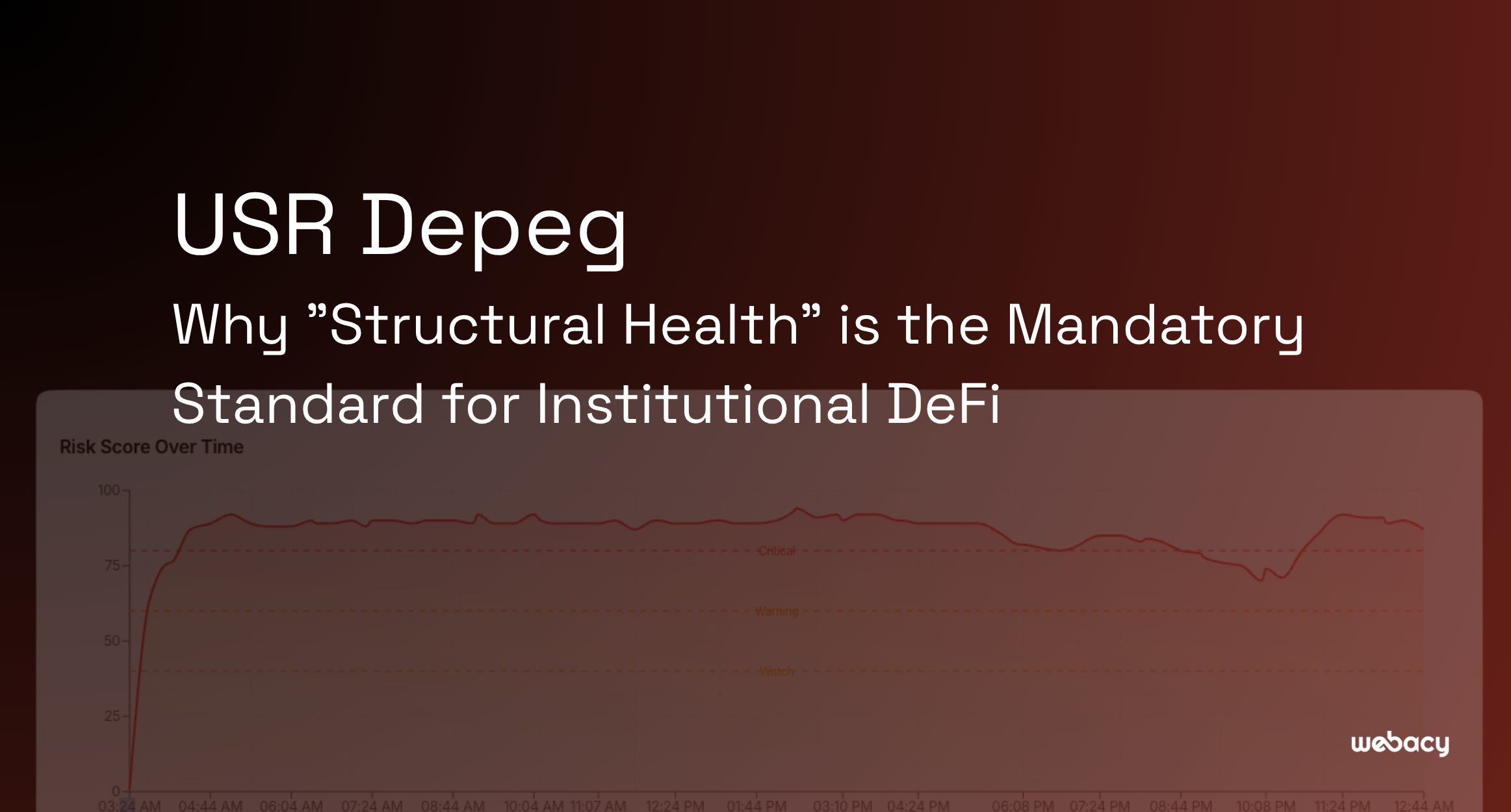
On March 22, 2026, USR (Resolv USD) experienced one of the most severe stablecoin depeg events in recent memory, losing more than 94% of its value within hours and reaching a low of $0.0545.
For both the DeFi community and TradFi institutions moving on-chain, this event underscores the importance of proactive risk observability. This post breaks down what happened, how our systems detected it, how we responded in real time, and what we’ve built since because real performance under stress matters more than polished hindsight.
At DD.xyz by Webacy, our Risk Engine was live-tracking the event. Our goal is to provide the structural health data that allows protocols and institutions to move from manual reaction to automated Decisioning.
What Happened
USR’s depeg was triggered by a minting exploit tied to failures in backing integrity and access control. Public reporting and on-chain analysis point to:
- Large-scale unbacked minting (~$80M from ~$200K collateral)
- Immediate sell pressure causing a rapid peg break
- Secondary losses across lending markets and vaults treating USR as ~$1 collateral
- Emergency pauses across multiple protocols
The impact was not limited to the token itself. It propagated through DeFi systems that relied on USR as stable collateral. The sudden illiquidity of USR triggered cascading liquidations across key lending protocols. Institutional vaults relying on USR as reliable collateral found their positions instantly underwater, forcing rapid, costly deleveraging and contributing to broader market instability.
Institutional vaults operate with significant capital, meaning even a small depeg event such as the one that drove USR to $0.0545 can result in multi-million dollar losses. Their primary challenge is the lack of real-time structural health data, forcing them to rely on manual reaction rather than automated Decisioning capabilities.
What We Detected
Effective risk management begins before the price moves.
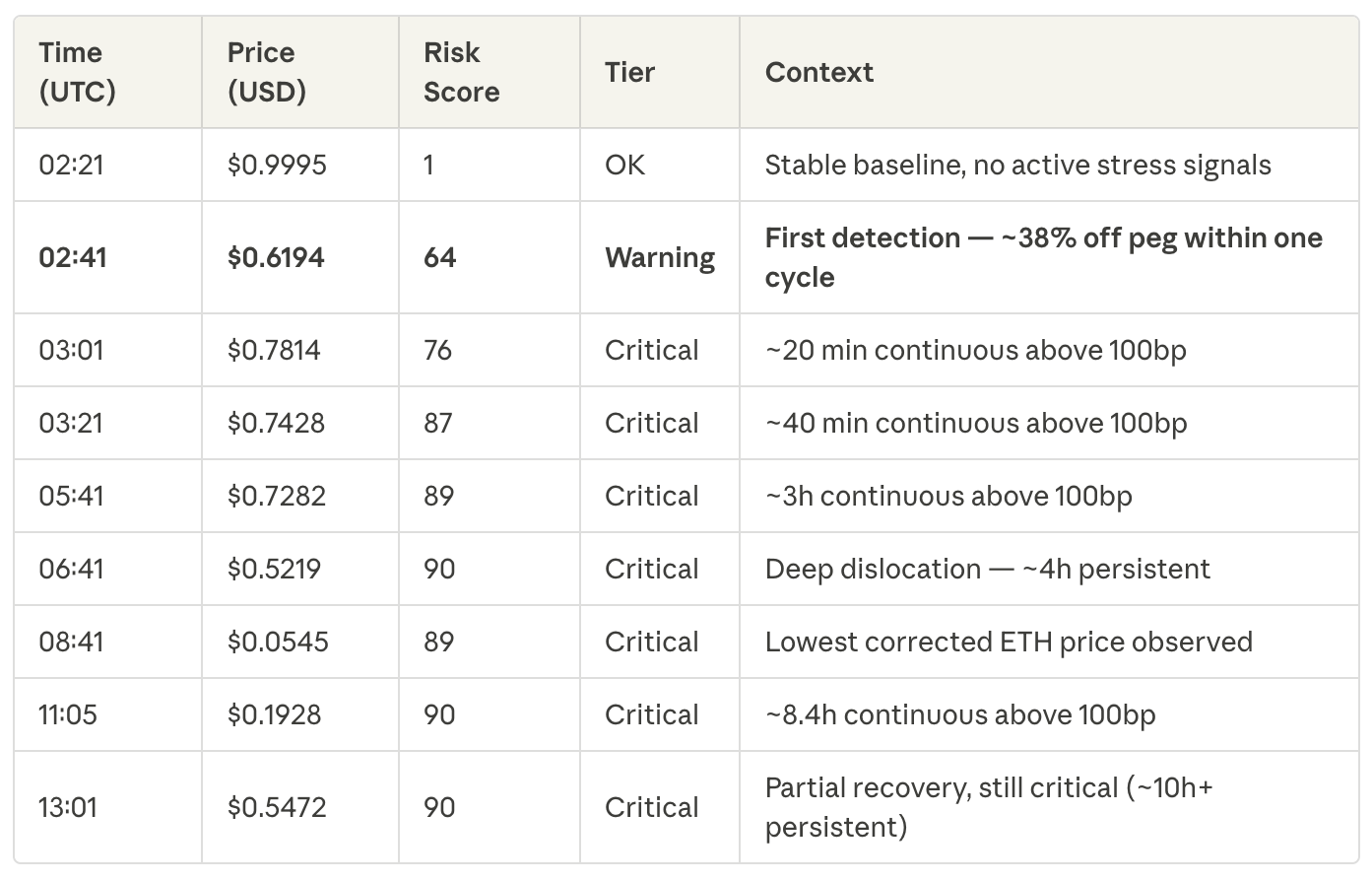
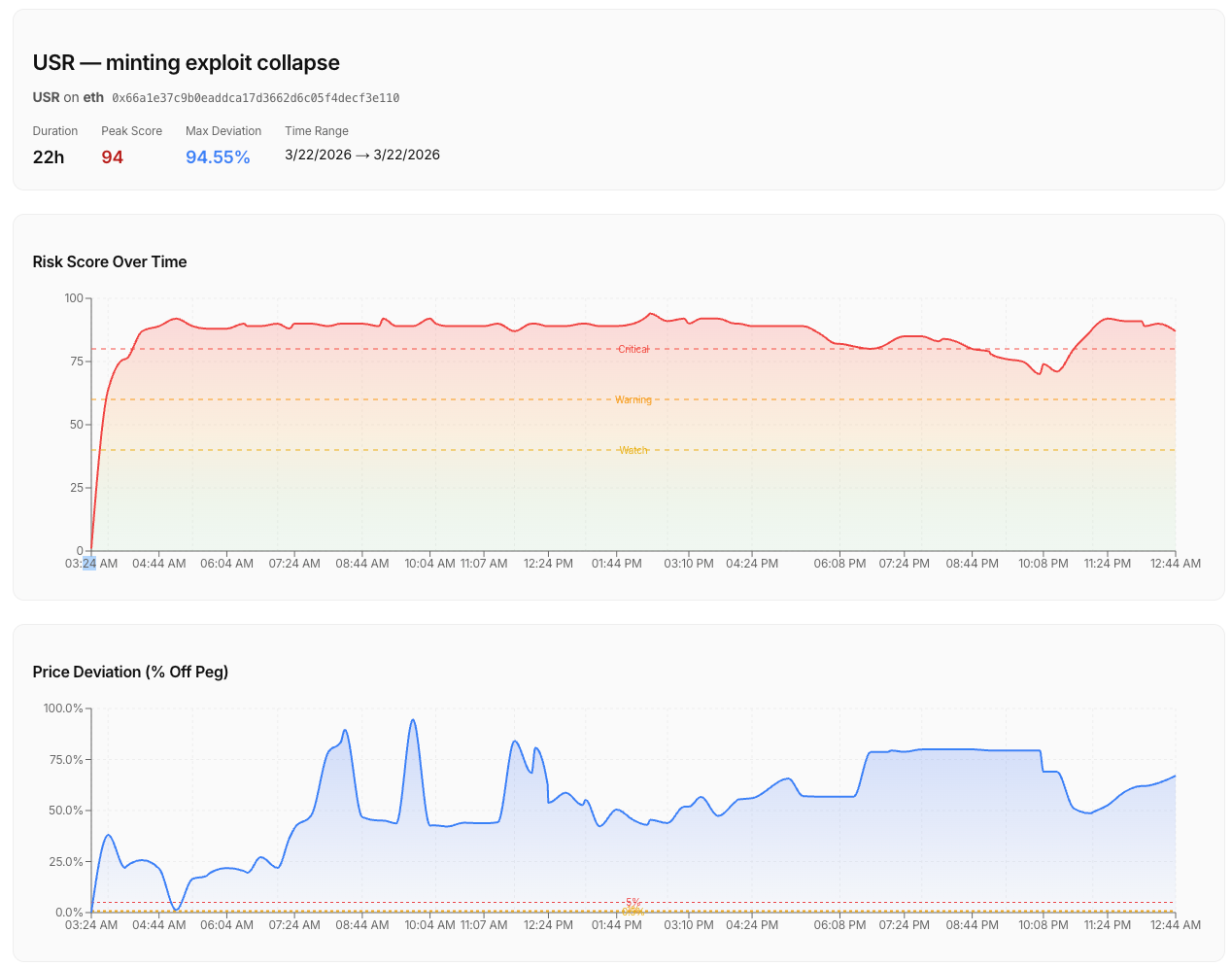
At 02:21 UTC, USR was trading at $0.9995 on Ethereum, a score of 1, fully stable, no active stress signals.
By 02:41 UTC, our multi-source pricing consensus had registered a 38% drop in a single monitoring cycle. The system escalated automatically.
Ethereum Detection Timeline
Detection Summary
- Time from near-peg → Warning: ≤ 20 minutes
- Time from Warning → Critical: ≤ 20 minutes
- Sustained Critical posture: 10+ hours
- Lowest corrected ETH price: $0.055 (~94.5% below peg)
Our persistence scoring kept risk tiers elevated across every subsequent monitoring cycle. Once USR crossed the 100bp deviation threshold, it did not clear for the remainder of the day.
Cross-Chain Coverage
USR is deployed across four chains. We tracked all of them simultaneously.
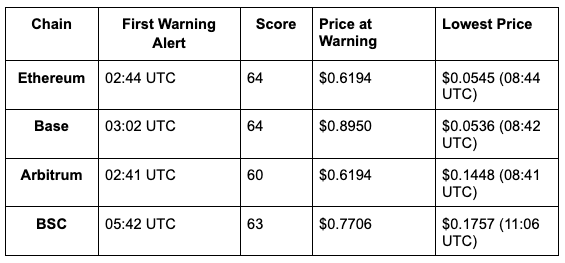
USR's BSC pool had very low liquidity. Our monitor flagged liquidity_tier: very_low with no 100K slippage data available. With thin trading volume, price on BSC lagged the broader market dislocation. The crash was already ~3 hours old on Ethereum before BSC DEX prices reflected it.
Supply Flows: A Corroborating Signal
Our Supply Flows system runs as a separate daily job, pulling on-chain mint and burn data from sources independently of the price monitor. Here is exactly what it showed on March 22 verified from our intraday snapshots.
- 00:58 UTC - USR had zero minting activity in the prior 24 hours, net burns of -346K, and a 30-day supply trend of -7.78% supply was actually contracting. At 02:18 UTC, just before the crash, the picture was identical: score of 1, tier `ok`, net 24h minting of essentially zero.
- 03:29 UTC - 48 minutes after our first price-level Warning, the Supply Flows system escalated USR to Critical (score 76). Important nuance: the mint data in DeFiLlama had not yet registered the fraudulent mints at this timestamp `minted_24h` was still only ~2,200 tokens. The Critical score at 03:29 was driven by the price depeg signal, which the Supply Flows scoring model incorporates. The supply had also dropped to 91.7M as market liquidations began burning USR.
- 04:23 UTC - Approximately 1 hour 43 minutes after first price detection the fraudulent mints appeared in our data. Our snapshot recorded 39.2 million USR minted in the 24-hour window, a +47.6% net supply change. Supply had swung from 91.7M back up to 121.6M despite the ongoing crash, a dramatic anomaly: the token was collapsing in price while supply was surging.
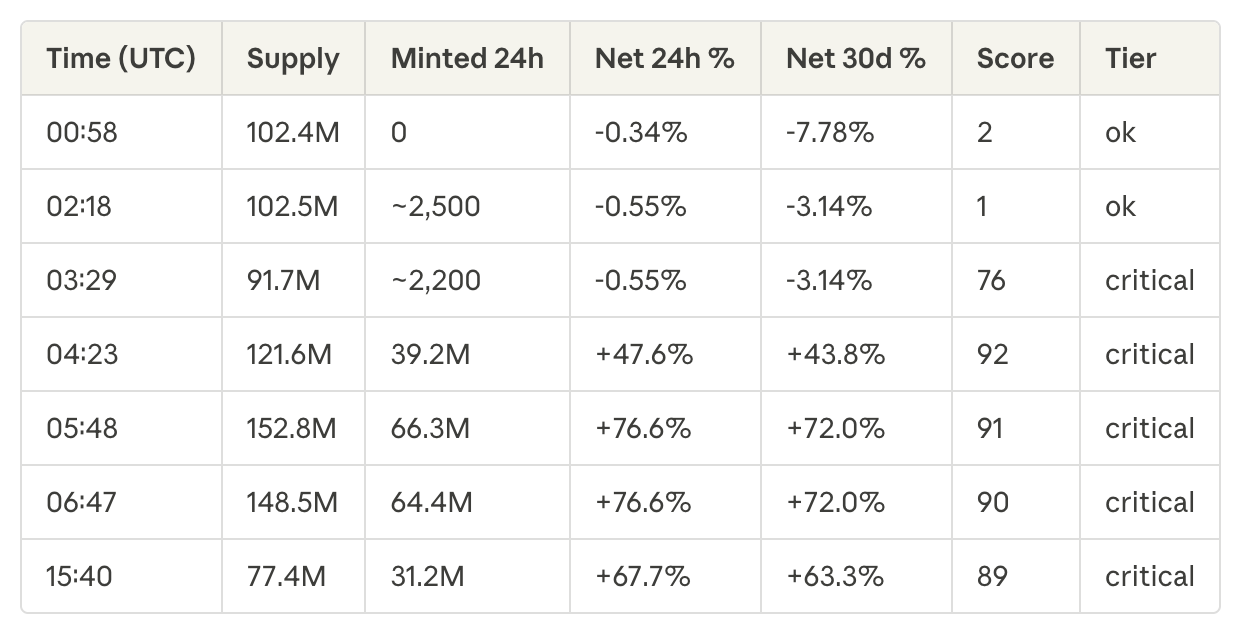
- 05:48 UTC - Our data showed 66.3 million USR minted in the 24-hour window, the peak of the fraudulent activity as registered. Supply had surged from a pre-incident baseline of ~102M to a peak of 152.8M, then collapsed to 77.4M by mid-afternoon as the market burned and liquidated USR holdings.
The +63.3% 30-day figure visible in our dashboard by end of day reflects the cumulative impact of the exploit minting registered in that window, not a pre-existing growth trend.
What the Supply Flows data confirms independently: a massive, sudden supply injection happened during the incident window, verifiable through a completely separate data pipeline from our price monitor. By 04:23 UTC, both systems were telling the same story from different angles: price collapsing, supply surging which is the on-chain signature of an unbacked mint exploit.
From Detection to Decisioning
In institutional risk management, the most expensive commodity is time. During the USR event, there was a massive lag between the initial exploit and the public's ability to react. DD.xyz effectively closed that gap for our partners.
The Reality of the Information Gap
- 02:21 UTC: System baseline is stable. First 50M USR minted on-chain.
- ~02:34–0:2:39 UTC: Price begins breaking peg (flagged by our persistence monitor)
- 02:41 UTC: Our Stablecoin Monitor detects a 38% price dislocation. The first high risk warning Notification is dispatched.
- 03:04 UTC: Our Stablecoin and Vault monitor issues first Critical Warning, a sustained depeg is alerted.
- 03:41 UTC: Second mint (30M USR)
- 04:58 UTC: Resolv Labs Public Announcement. The protocol officially confirms the exploit and pauses functions.
DD.xyz partners received their first actionable alert 2 hours before the official public announcement. While the broader market was still trading against a "ghost peg," our clients had already been notified of the structural failure.
The Defensive Flow: Token Risk to Portfolio Action
Our monitor uses multi-source pricing with persistence scoring. USR escalated into high risk state at 02:41 UTC and has not left it. As of publication (March 23), it scores 100 Critical across all four chains with prices between $0.20–$0.32 the peg has not recovered.
A stablecoin depeg is never isolated; it is a system-wide contagion. Our architecture ensures that a single token failure triggers a sitewide defensive posture through our Vault Overlay:
- Step 1 (The Trigger): The Stablecoin Monitor identifies the de peg break and escalates the risk tier.
- Step 2 (The Propagation): This risk is immediately "inherited" by every vault and structured product holding USR.
- Step 3 (The Action): USR exposure was not just flagged at the token level. Vaults holding USR were automatically escalated, assigned higher risk scores, and marked with Exit Recommendations.
The Result: We translate "Token Risk" into "Portfolio Signals," allowing managers to see exactly which parts of their AUM are contaminated in real-time. By the time automated allocators or manual interventions began at 05:00 UTC, the "exit window" for manual treasury management had been open for over two hours for those using DD.xyz telemetry.
Post-Event Hardening: What We Shipped
We treat every market dislocation as a blueprint for better defense. Following the USR incident, we have deployed a couple major institutional signals:
- Single-Key Mint-Role Flagging: identifies stablecoin contracts where minting authority is held by a single address, the structural condition that made the USR exploit possible
- TVL/Supply Divergence: detects when on-chain circulating supply grows faster than reported collateral backing, surfacing potential unbacked minting in real time
The Institutional Bottom Line
The USR incident validates three core principles of the DD.xyz mission:
- Depegs are Systemic: The price break is just the start. The real damage happens in the lending markets and vaults that treat the asset as collateral.
- Cross-Chain is Mandatory: USR traded differently on every chain. A single-chain view is an incomplete and dangerous picture. For a treasury or vault with multi-chain exposure, the 3-hour lag on BSC represented a clear arbitrage or hedging window that was only visible to those with simultaneous cross-chain monitoring.
- Speed is Safety: Our detection happened in the same cycle as the first market dislocation.
Acknowledgements
We'd like to thank our partners at Trading Strategy for their support. Building reliable DeFi risk infrastructure takes a village, we're grateful to have them in ours.
A Partner in Resilience: Moving Forward Together
At DD.xyz by Webacy, we recognize that behind every "Critical" alert is a team working tirelessly to protect user funds and institutional integrity. The USR incident was a stark reminder of how quickly structural gaps can lead to systemic stress. Our mission is to ensure you never have to navigate those gaps in the dark.
Commitment to Precision (Limitations & Caveats)
We believe in the same transparency we demand from protocols. While our systems provided a lead over public announcements, we are constantly refining our telemetry:
- Snapshot Cadence: Our internal monitoring captures data at high frequency, but intra-interval extremes (the "absolute low" tick between 02:38 and 03:00 UTC) may vary across different DEX aggregators.
- Cross-Chain Divergence: During extreme volatility, prices diverge significantly. We report per-chain normalized values to ensure you see the reality of the pool you are actually in.
- Estimated Data: Figures regarding total exploit size ($80M) are based on current on-chain verification and remain subject to final post-mortem revisions from Resolv and Gauntlet.
Our Offer: Strengthening Your Protocol's Heartbeat
We know that the work of securing a protocol never ends. Whether you were impacted by the USR event or are currently auditing your exposure to high-yield vaults and stablecoin collateral, we want to help you build a more proactive defense.
To support the growth of a safer DeFi ecosystem, we are offering:
1 Month of Complimentary Vault Monitoring for any new client vaults or RWA integrations. We will deploy our Stablecoin Monitor, Vault Overlay, and Risk x Flow Matrix on your specific stack to give you the same real-time telemetry that protected our partners this week.
Don't wait for the next autopsy. Let’s build your "Day 0" plan today.
Reach out to our Risk Team or DM us at @mywebacy to get started or email us at [email protected]