
On October 29, attackers took about $6.3 billion from Binance, the largest crypto theft on record. Binance suspended withdrawals and said it would cover all losses. Tether and Circle froze more than $2.3 billion of their stablecoins.
We tracked six dollar-backed stablecoins for the next 18 hours: USDT, USDC, RLUSD, FDUSD, USD1 and BUSD. Prices stayed close to $1 wherever the tokens traded actively. Webacy's risk scores still rose within two hours.
Prices
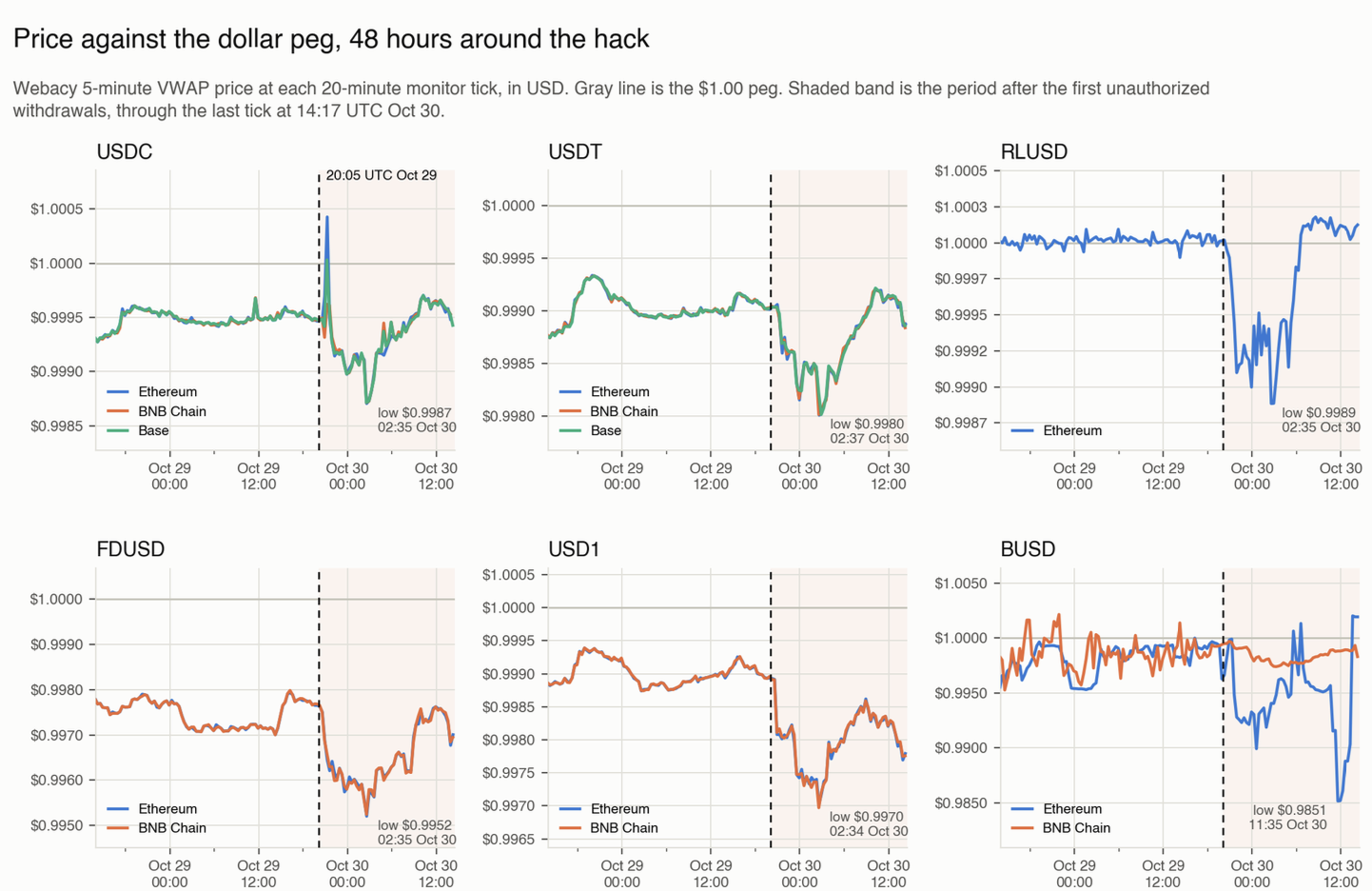
Five of the six hit their lows about 6.5 hours after the theft began:
- FDUSD: $0.9952
- USD1: $0.9970
- USDT: $0.9980
- USDC: $0.9987
- RLUSD: $0.9989
Most of the drop reversed by 09:00 UTC. FDUSD and USD1 had already dipped to $0.9970 and $0.9987 the day before.
BUSD on Ethereum fell to $0.9851. That market is small, at about $34 million, with no reported trading liquidity on decentralized exchanges.
Risk scores
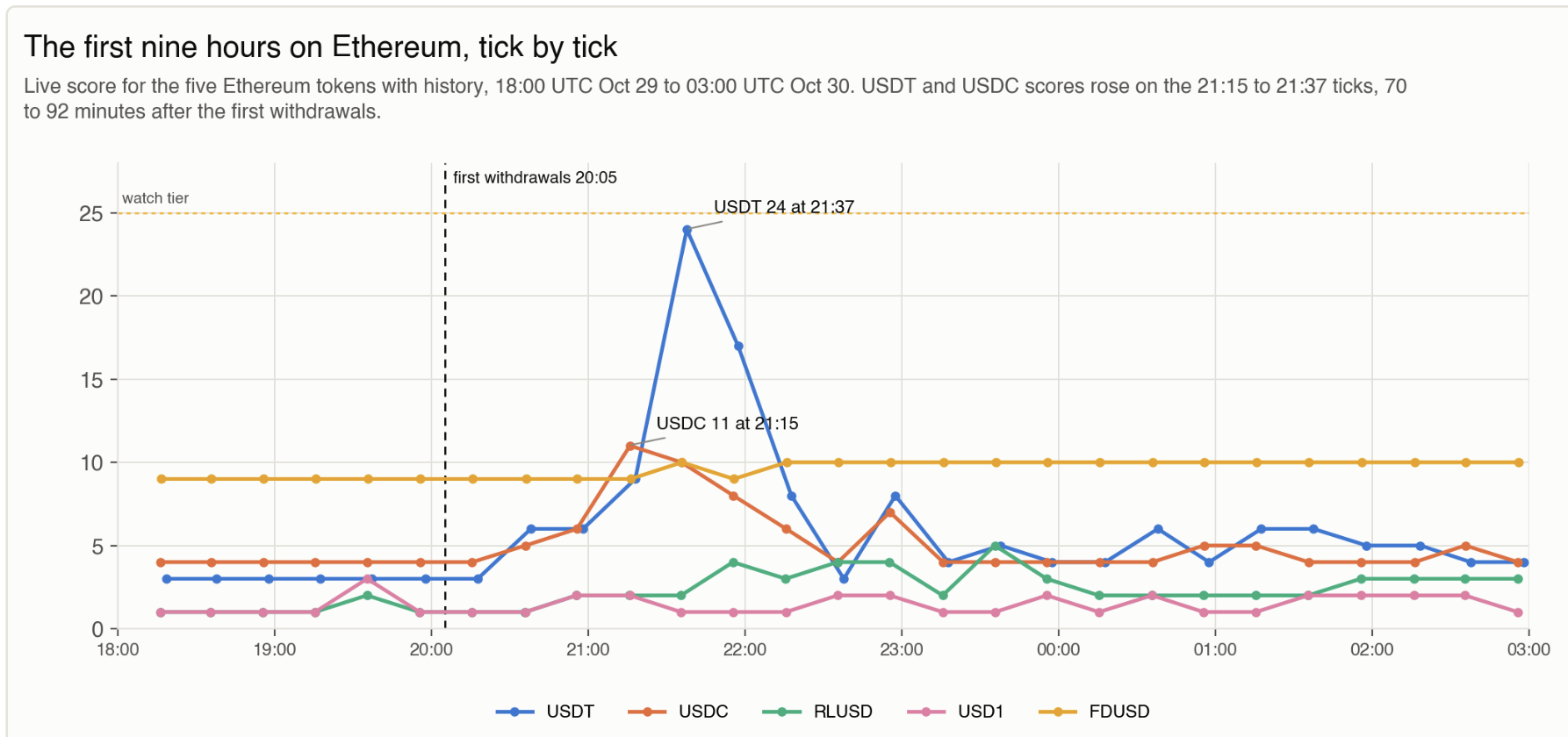
Webacy scores each stablecoin from 0 to 100 continuously, using market, liquidity, supply and reserve data. A score of 25 or higher moves a token to our watch tier.
USDT on Ethereum rose from 3 to 24 within 92 minutes of the first withdrawals. USDC on Ethereum rose from 4 to 11. USDT was trading at about $0.9986 at its peak, a gap that accounts for roughly one point of the 24.
The rise was short. USDT was back to 8 within 40 minutes, and none of the six reached watch.
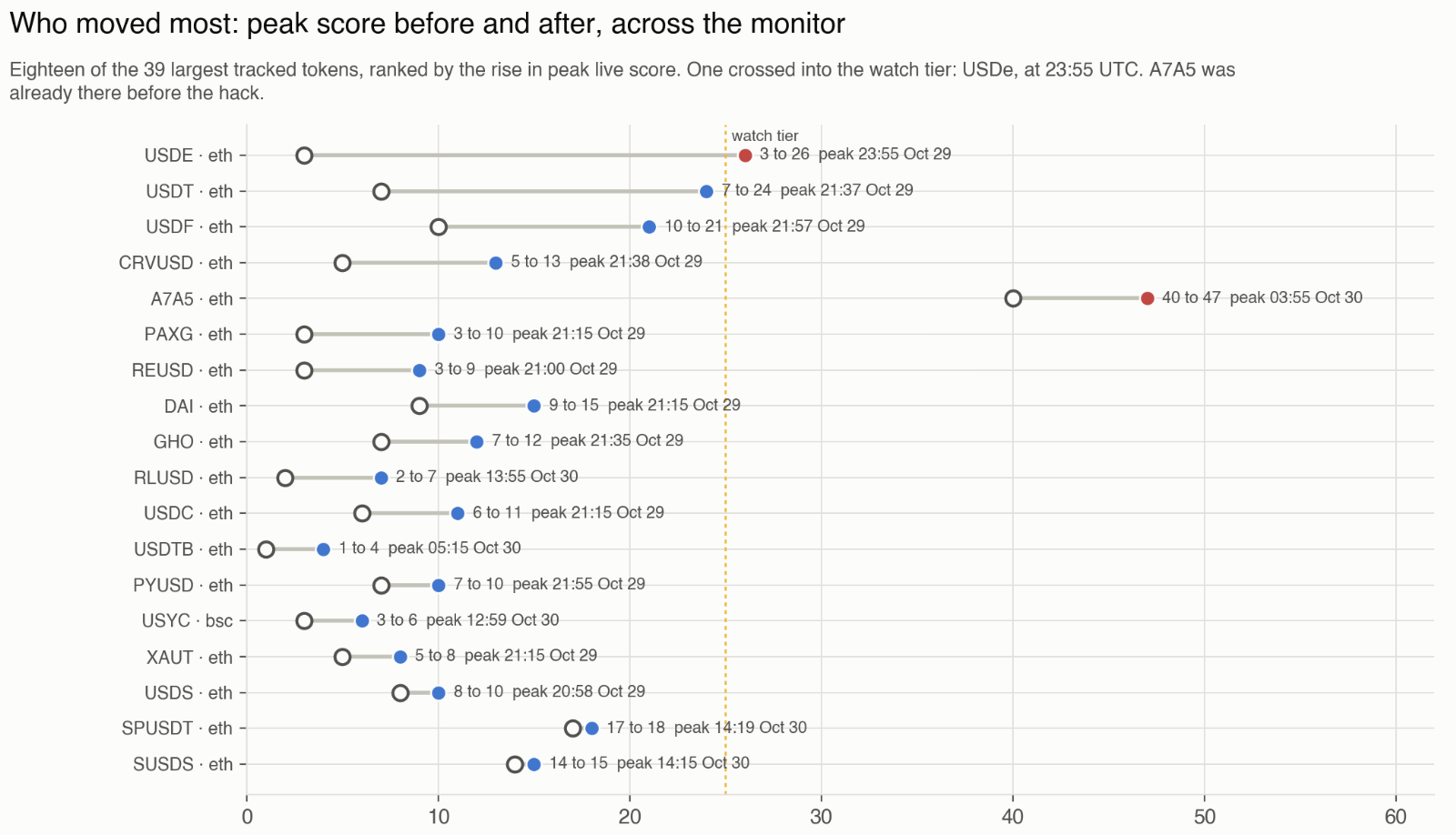
Of the 39 largest tokens we monitor, 24 scored higher after the hack than the day before. One, USDe, reached watch, at 26.
Supply and liquidity
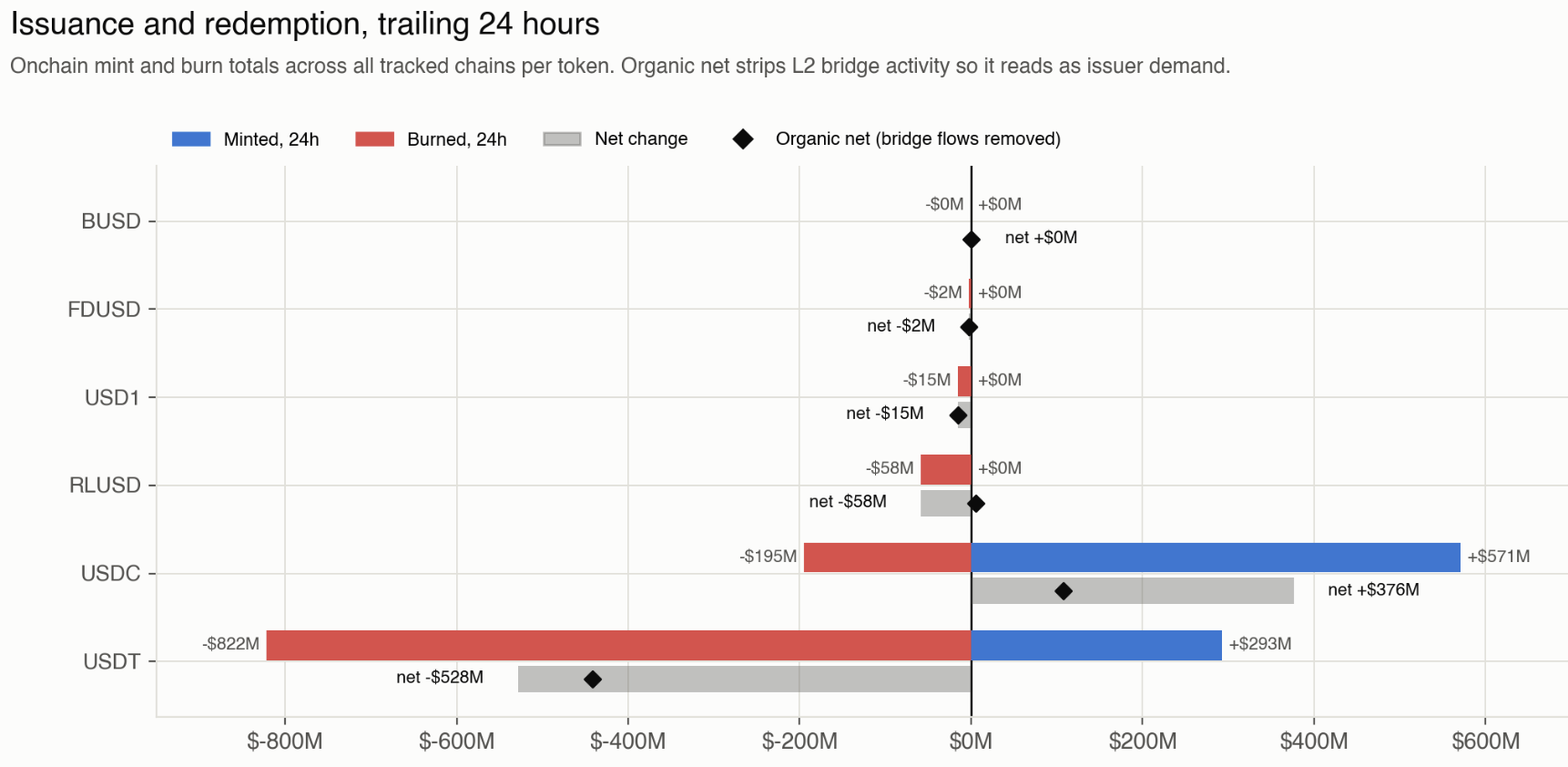
In the 24 hours to 14:17 UTC on October 30, USDT supply fell by a net $528 million and USDC supply rose by a net $376 million. USDT supply had already fallen $2.22 billion over seven days, so the hack may not explain the full drop.
RLUSD's liquidity on decentralized exchanges was 57.8% below its 7-day average, while its price stayed above $0.998.
Peg Canary, our early-warning score, measures conditions that have preceded past stablecoin failures, such as supply and liquidity changes. At 09:49 UTC on October 30, it placed five of the 13 token-and-network pairs we tracked on watch, led by RLUSD at 34 out of 100.
Could a stablecoin have lost its $1 value?
Nothing in this data shows that any of the six came close.
A stablecoin needs buyers when holders sell, and holders need to trust they can redeem it for $1. Past failures involved doubts about the issuer. FDUSD fell to about $0.91 in April 2025 after insolvency allegations, and USDC fell to about $0.87 in March 2023 over its reserves at Silicon Valley Bank.
This theft hit an exchange, and the exchange pledged to cover the losses. A token with less liquidity or doubts about its reserves could react differently to the same pressure.
What risk teams can do
Price alone would not have shown the risk increases or a stablecoin's liquidity drop. After a market shock, check liquidity, supply and redemptions.
Live data is on DD.xyz.
Data through October 30, 2026, 14:25 UTC. Risk scores and Peg Canary are separate models. Not investment advice.