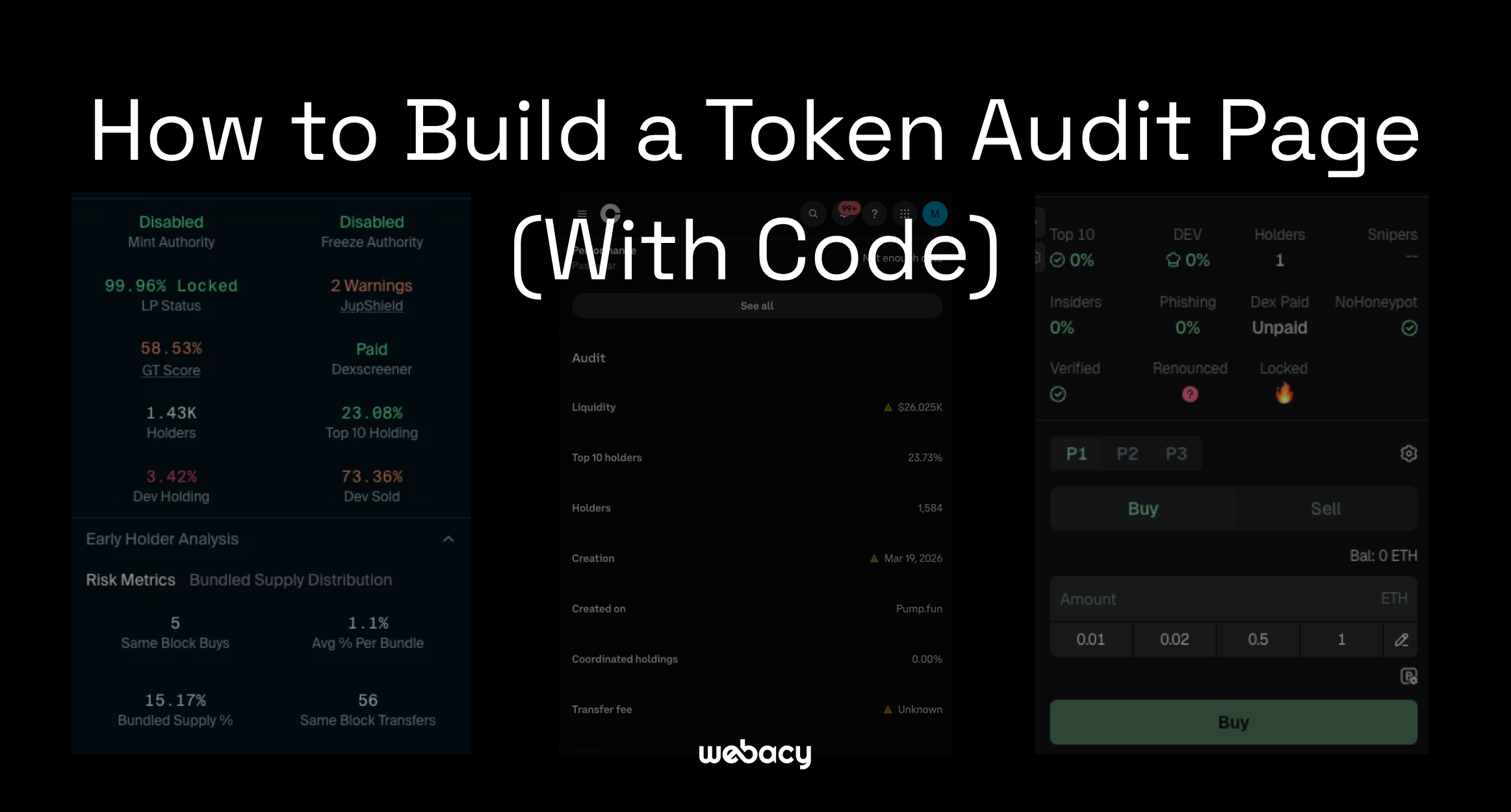
Most token pages show price, charts, and volume.
Very few show what actually matters:
→ risk
If you’re building a DEX, trading app, token explorer or otherwise, adding a token audit layer is one of the fastest ways to:
- improve user trust
- reduce bad trades
- differentiate your UI
This guide shows how to build a full token audit page in minutes using a single API.
What is a Token Audit Page?
A token audit page gives users insight into whether a token is safe to trade.
Typical signals include:
- honeypot detection
- liquidity risk
- holder concentration
- contract vulnerabilities
- behavioral anomalies
This is what some trading apps surface, but most don't implement it natively.
!Follow the developer guide here!
⚙️ Step 1: Fetch Token Risk Data
Grab an API key here.
Use our token intelligence API:
curl --request GET \
  --url https://api.webacy.com/trading-lite/{address} \
  --header 'x-api-key: {YOUR API KEY}'
This returns:
- Contract Address (CA)
- Deployer Address (DA)
- Dev Analysis
- Top 10 Holders
- Sniping
- Bundling
- Total Holders
- Metadata
- Mintable
- Freezable
🧱 Step 2: Structure Your UI
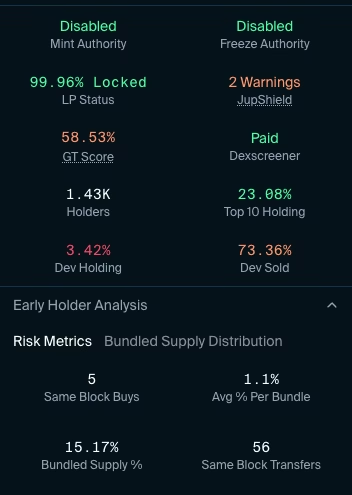
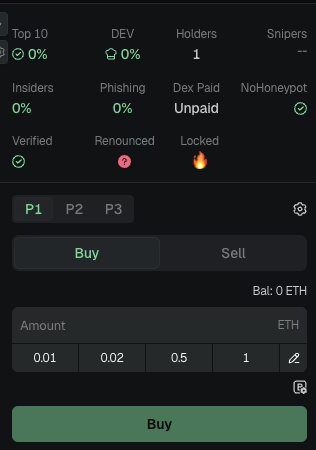
At minimum, your token audit page should include:
Risk Score
- Simple visual indicator (low → high risk)
Key Warnings
- Honeypot detected
- Unlocked liquidity risk
- Suspicious contract behavior
Supporting Data
- holder concentration
- liquidity depth
- contract verification
⚡️ Example Layouts
🚀 Live Demo
Want to see what this looks like instantly?
👉 Check out DD.xyz
Paste any token address and see the full audit output.
🧠 Why This Matters
Most users don’t understand smart contracts.
Most users can't analyze unfair token launches.
But they do understand:
- “High risk”
- “Honeypot”
- “Liquidity can disappear”
Adding this layer:
→ makes your product more intelligence
→ increases user confidence
→ reduces support issues
👉 Get Started
Add token intelligence to your app in minutes:
👉 https://docs.webacy.com/token-intelligence