As the GENIUS Act and MiCA move from legislation to live enforcement, institutions holding or servicing tokenized assets face an expanding liability surface that KYC and AML frameworks were never designed to address, and the regulatory frameworks themselves now assume structural risk monitoring that most institutions don't have.
Tokenized assets inherit a five-layer attack surface spanning smart contract logic, oracle feeds, admin key management, collateral quality, and contamination propagation, none of which AML/KYC tooling can detect, and all of which can trigger catastrophic loss before any compliance alert fires.
Tokenized Asset Risk: What AML Can't Protect You From
The regulatory frameworks are finally here. The GENIUS Act is signed. MiCA is in full enforcement. Reserve requirements, monthly audits, instant redemption rights are all mandated. And yet, in half a year alone, RWA tokenization protocols lost over $14.6 million to exploits that had nothing to do with compliance failures. Every one of those hacks passed AML screening. Every one of them had KYC'd counterparties.
The problem isn't a lack of regulation. The problem is that the risks now embedded in tokenized assets are structural, not behavioral, and most institutions aren't measuring them.
TL;DR
- AML and KYC are necessary but structurally insufficient for tokenized asset risk. They screen counterparties, not code, collateral, or financial market mechanics
- The real risk surface in tokenized assets spans smart contract vulnerabilities, oracle manipulation, admin key compromise, collateral contamination, and depeg propagation
- GENIUS Act and MiCA both implicitly require continuous structural monitoring (not just compliance programs) through reserve adequacy, redemption liquidity, and risk management mandates
- Oracle manipulation alone accounted for $8.8 billion in losses in 2025; over 60% of new DeFi deployments still rely on single-source oracle feeds
- Continuous risk ratings, not periodic audits, are the only mechanism that can detect structural failure in real time
- Webacy's Digital Asset Ratings detected the USR depeg 2 hours 17 minutes before Resolv Labs' official announcement, flagging a 38% dislocation from an unbacked minting exploit
The Risk Nobody's Regulating
When most compliance teams think about digital asset risk, they think about two things: who is the counterparty, and is this wallet flagged. This is the AML/KYC paradigm. Screen the actors, enforce the rules, move on. It's not wrong but it is incomplete.
Tokenized assets, from stablecoins to RWA-backed vaults to yield-bearing DeFi positions, carry a category of risk that compliance programs weren't designed to capture. This risk is structural. It lives in the code, the collateral, the oracle feeds, and the interconnection between protocols. It doesn't show up in a sanctions database. It doesn't get caught by a travel rule check. And it can wipe out 94% of an asset's value before a single compliance alert fires.
Understanding what this risk actually looks like and what the new regulatory frameworks implicitly demand in response is now a core competency for any institution operating in or alongside digital assets.
The Five-Layer Risk Surface of a Tokenized Asset
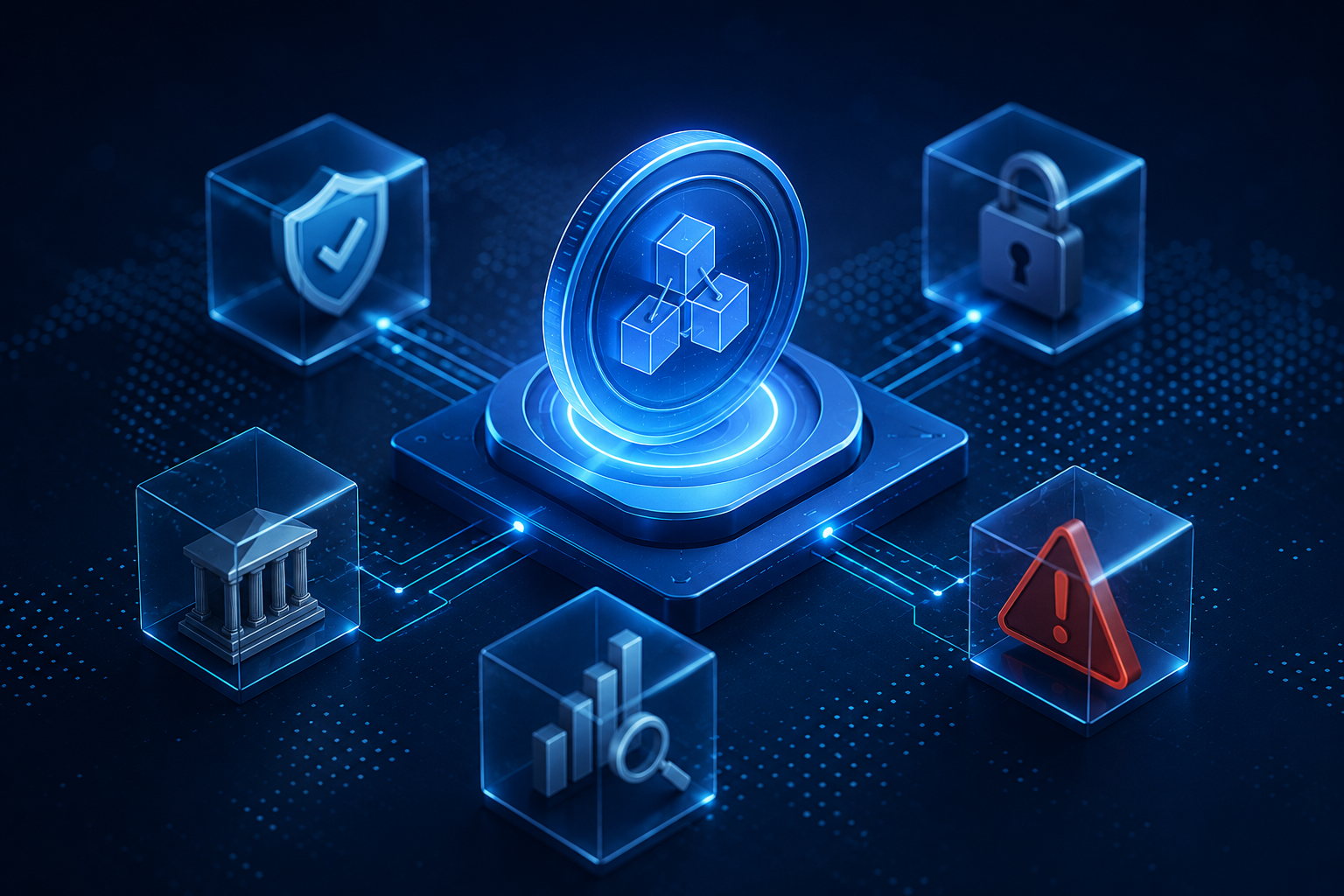
A tokenized asset is not a simple instrument. Whether it's a stablecoin, an RWA token representing T-bills, or a vault position yielding 5% annually, the value of that token depends on a chain of components functioning correctly and simultaneously. Below are five layers of risk that outline the risk surface of a tokenized asset.
Each layer is a distinct attack surface:
1. Smart Contract Risk
The code governing minting, transfers, upgrades, and redemption can contain logic errors or vulnerabilities. Audits help, but audits are point-in-time snapshots. Post-audit upgrades, governance changes, and newly discovered attack vectors mean a protocol that was "clean" in January can be exploitable by March. In March 2025, a compromised private key in the Zoth restaking protocol resulted in an $8.5 million loss. A classic single-point failure that a multi-sig with a timelock would have prevented.
2. Oracle Risk
Blockchain smart contracts are closed systems. They rely on oracle feeds (external data bridges) to access real-world pricing, exchange rates, and market data. This makes oracles one of the most exploited components in DeFi. In February 2026, a DeFi lending protocol lost $1.78 million when a governance proposal misconfigured an oracle wrapper, causing an asset to be priced at approximately $1.12 instead of its market value near $2,200, a 99.95% misconfiguration. More than 60% of new DeFi deployments still rely on single-source oracle feeds, despite the availability of resilient alternatives. Oracle manipulation alone accounted for an estimated $8.8 billion in losses across 2025.
3. Admin Key and Governance Risk
Who can upgrade the contract? Who can pause redemptions? Who can modify collateral parameters? In most protocols, the answer is a small set of privileged keys or a governance vote that can be captured. Admin key compromise is one of the most persistent and underappreciated risks in the RWA sector and it's entirely invisible to AML tooling.
4. Collateral and Reserve Quality Risk
For stablecoins and RWA tokens, the token is only as good as what backs it. Reserve composition matters: cash and short-term Treasuries are not the same risk profile as longer-dated instruments, illiquid positions, or opaque off-chain assets with fraudulent attestations. Quarterly audits can miss what happens between reporting periods. Real-time reserve monitoring is a fundamentally different capability than an annual attestation.
5. Contamination and Propagation Risk
DeFi protocols don't operate in isolation. A stablecoin depeg doesn't stay contained. It propagates through every vault, pool, or protocol that accepted that stablecoin as collateral. A single compromised oracle affects every contract consuming that feed. This interconnection means that the risk profile of any one position is inseparable from the risk profile of the protocols it touches. Mapping this contamination vector requires infrastructure, not checklists.
What GENIUS, MiCA, and the Global Frameworks Are Actually Asking For
The narrative around GENIUS and MiCA has centered, understandably, on AML/KYC, reserve requirements, and licensing. These are the floor. But reading the actual mandates closely reveals something more demanding.
The GENIUS Act classifies all permitted stablecoin issuers as financial institutions under the Bank Secrecy Act and mandates comprehensive AML/CFT programs, but it also requires technical capability to block and freeze transactions in secondary markets, and directs regulators to set rules for "financial soundness" and "risk management standards." The Financial Stability Board, writing in October 2025, was explicit that even where stablecoin regulation has been implemented, critical gaps remain: "insufficient requirements for robust risk management practices, capital buffers, and recovery and resolution planning."
MiCA goes further in some respects. Fully operational as of mid-2025, MiCA requires segregated reserves, daily redemption rights, and strict governance and it explicitly sits alongside the EU's Digital Operational Resilience Act (DORA), requiring that MiCA compliance be integrated into enterprise-wide risk programs. The implication is clear: operational resilience for a tokenized asset isn't just a compliance program. It's an ongoing, live capability.
The gap between what AML/KYC can cover and what these frameworks implicitly demand is exactly where structural risk monitoring lives. Monthly reserve attestations don't tell you what's happening to collateral quality right now. Wallet screening doesn't tell you if the oracle your vault depends on has been misconfigured. KYC doesn't tell you if the stablecoin backing your T-bill token just depegged.
What Continuous Risk Monitoring Changes
Consider what happened on March 22, 2026.
At 02:41 UTC, Webacy's Digital Asset Ratings monitor detected a 38% price dislocation in USR Resolv USD. No announcement had been made. No alert had been issued by Resolv Labs. The signal came from the structural monitoring layer: collateral mechanics, on-chain reserve behavior, and market pricing diverging beyond explainable parameters.
By 03:04 UTC, Webacy had issued a Critical alert. The underlying cause was an unbacked minting exploit, exactly the kind of structural failure that does not show up in AML screening, does not appear in a KYC check, and would not have been flagged by a quarterly attestation.
At 04:58 UTC, Resolv Labs made the event official. USR had lost 94% of its value. The gap between Webacy's first signal and the public announcement was 2 hours and 17 minutes.
This is the operational reality of continuous structural risk monitoring versus periodic review. The difference isn't methodological. It's the difference between acting on information and learning about it after the fact.
Webacy's Digital Asset Ratings, live at DD.xyz, rate stablecoins and vaults on a 0–100 composite score (with letter-grade ratings) built from sub-scores, covering stablecoin depeg monitoring, contamination propagation mapping, smart contract risk, and Vault Technical Risk Rating. Hard floor overrides apply for critical structural conditions. Every score traces to a specific, explainable structural condition, not a black-box output.
FAQ
What risks in tokenized assets are not covered by AML/KYC frameworks?
AML and KYC programs screen counterparties and transaction patterns for signs of illicit activity. They do not assess smart contract logic, oracle feed integrity, collateral quality, governance attack surfaces, or cross-protocol contamination risk. These structural risks are the primary vectors for loss in RWA and stablecoin protocols and they require dedicated risk infrastructure, not compliance programs.
Does the GENIUS Act require structural risk monitoring beyond AML?
The GENIUS Act mandates AML/CFT programs as the compliance floor, but it also directs regulators to establish rules for financial soundness, technical capabilities, and risk management standards. The Financial Stability Board has separately flagged that current stablecoin regulations leave critical gaps in "robust risk management practices, capital buffers, and recovery and resolution planning." Institutions relying solely on AML compliance will likely face additional scrutiny as these rules are finalized through mid-2026.
What is a vault technical risk rating?
A vault technical risk rating is a composite score such as Webacy's 0–100 rating built from sub-scores that assesses the structural health of a DeFi vault across dimensions including smart contract security, oracle dependency, governance attack surface, collateral composition, and liquidity mechanics. Hard floor overrides apply when a critical structural condition is detected, regardless of other scores. Every component score is traceable to a specific observable condition.
How does oracle manipulation affect tokenized assets specifically?
RWA tokens depend on oracle feeds to price collateral, execute liquidations, and verify reserve adequacy. A manipulated or misconfigured oracle can cause a protocol to accept undervalued collateral, over-issue tokens, or execute incorrect liquidations, often in a single transaction block, before any manual review is possible. Oracle manipulation was the second most damaging attack vector in DeFi in early 2025 and accounted for the second-largest RWA exploit of the year.
Conclusion
Compliance isn't the same as risk management. The regulatory frameworks arriving in 2026 (GENIUS, MiCA, FSB guidance, DORA) set an important floor. But the structural risk surface of tokenized assets extends well beyond what any compliance program was designed to address.
The institutions that will operate with confidence in this market are the ones that can answer a different set of questions: Is this stablecoin structurally sound right now? Is the oracle feeding this vault trustworthy? What happens to my position if the protocol two layers upstream depegs? Is the composite risk score on this vault moving toward a critical threshold?
These are not compliance questions. They are risk infrastructure questions. And the answer has to be continuous, not quarterly.
Explore Webacy's Digital Asset Ratings at webacy.com or see the live monitor at DD.xyz.