
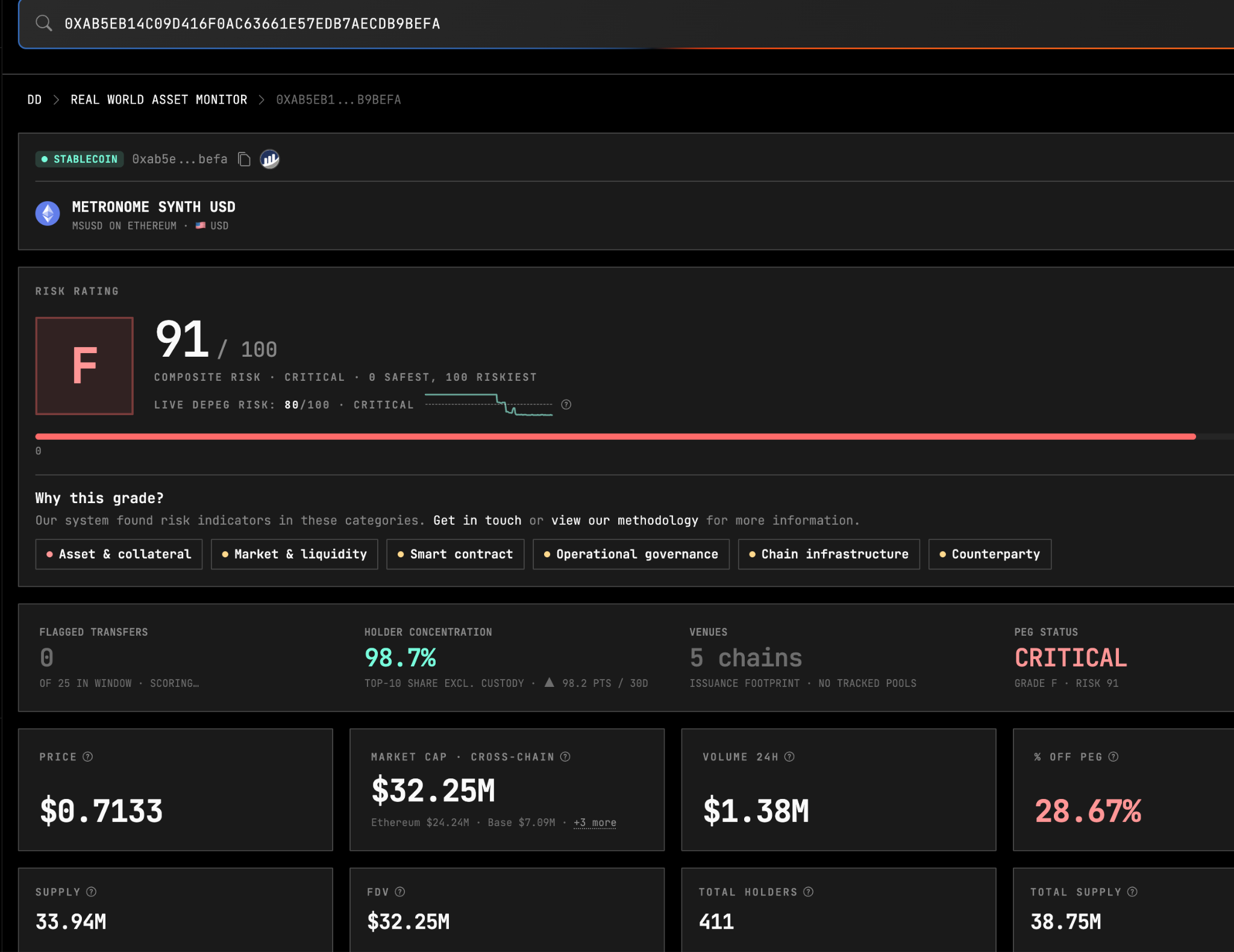
In June we wrote about the recent Main Street Stablecoin Depeg MSUSD. This article is about the recent Metronome's msUSD depeg. Today both msUSDs are failing (Metronome's msUSD grades out at F), but they sit at completely different prices: Metronome's is down around $0.73, and Main Street's is far worse, still near $0.31.
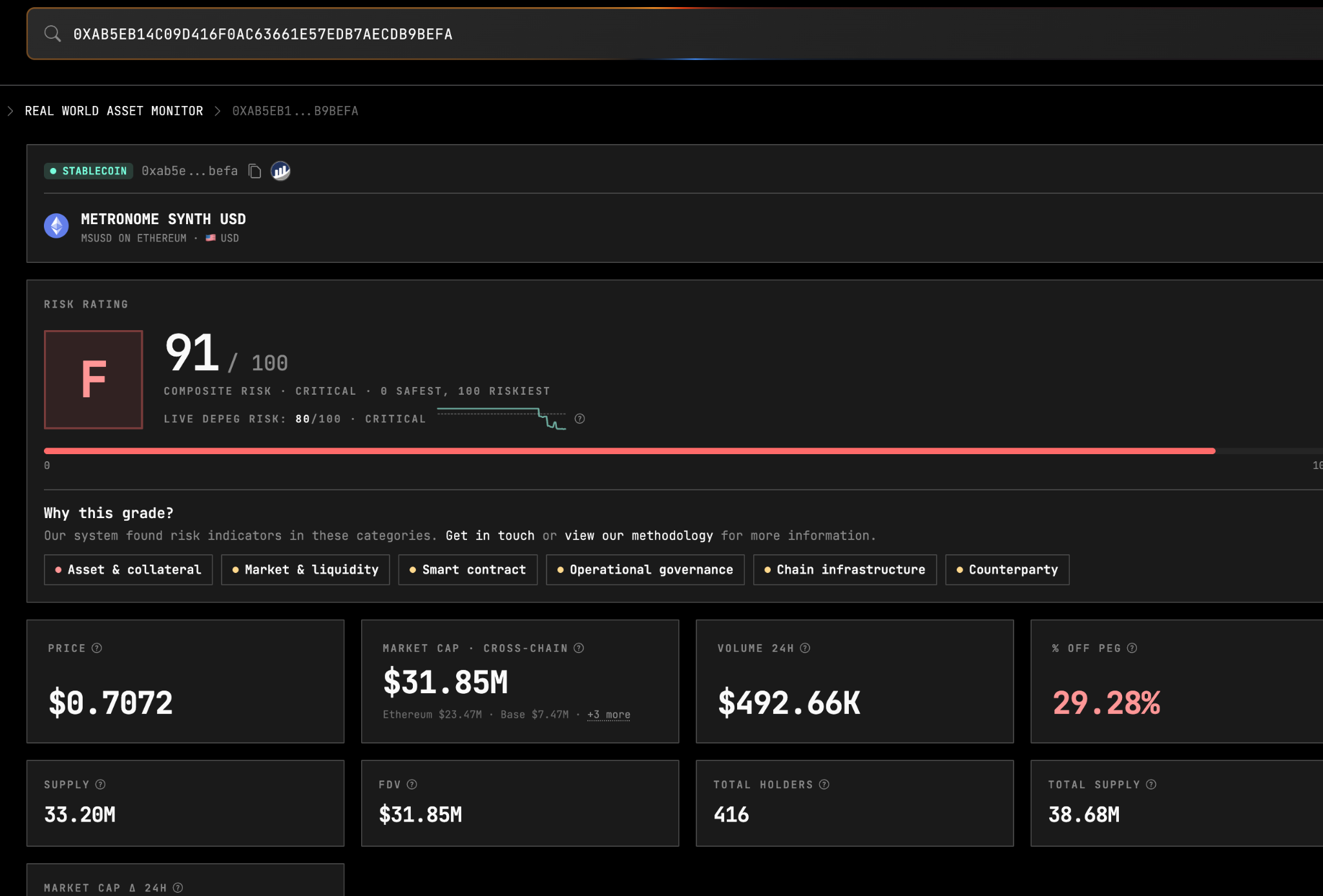
msUSD is trading at $0.7326, about 26.7% under peg, and its Peg Canary Score in our system sits at 80/100 (DANGER). Over the last 30 days it minted 78.1M tokens on Ethereum across 5,654 transactions, roughly 2.8× the ~27.7M in circulation there. Two Metronome vaults holding about $22.3M of it are already flagged EXIT.
A stablecoin can break for many different reasons, and which one it is tells you almost everything about what happened. Sometimes the backing gets pulled out from under it: holders redeem, reserves drain, and the promise quietly thins until the price finally catches up. That's the version we took apart in June, when Main Street's msUSD fell about 80% in a day after its reserve verifier walked. The alarm that time wasn't just the price. It was redemptions, money exiting the ecosystem before anything showed up on a chart.
This one runs the other way. Here the supply gets expanded faster than the backing can keep up, tokens printed into the market at a pace no honest reserve is going to match, until each one is worth less than a dollar and the market says so. And, awkwardly, the token is also called msUSD, Metronome's synthetic dollar.
What the price showed: almost nothing
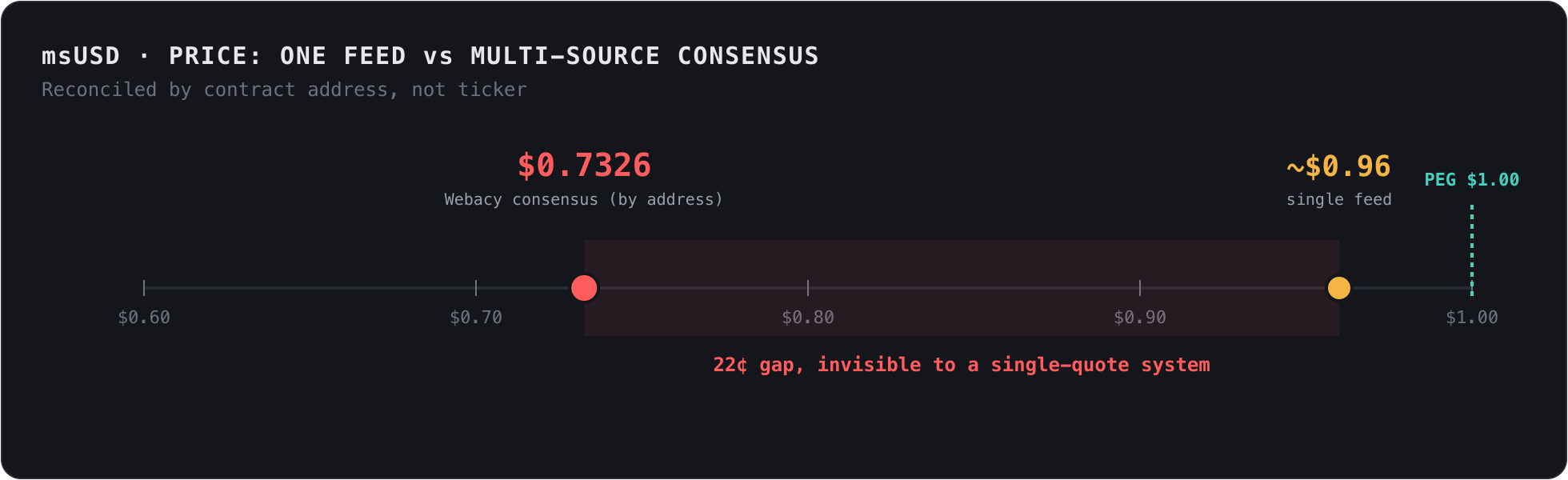
Most peg-risk systems watch one thing: the price quote. And for most of the back half of July, a popular price feed (the kind wired into dashboards, lending parameters, and portfolio trackers) still had Metronome's msUSD sitting right around $0.96. Close enough to a dollar to look like an ordinary stablecoin wobble, and easy to overlook.
This happens more often than you would think, which is why our engine pulls several price sources, measures how far apart they are, and builds a consensus across them. On msUSD they were more than twenty cents apart. Verifying via multiple oracle consensus, the accurate number is $0.7326: a token trading a quarter under its peg:
This is the pattern we keep running into: the on-chain signals arrive before the depeg. And a stale oracle can have drastic consequences. Protocols keep marking the collateral near par, so lending, minting, and liquidations all run off a number that's already wrong, and the exposure compounds. By the time one feed admits there's a problem, the behavior that caused it has usually been sitting on-chain for days. The edge isn't reacting to the red candle a beat faster than the next desk. It's reading the on-chain signals that become the candle, days before it prints, while there's still time to act.
And for msUSD this wasn't hypothetical. Our consensus read $0.73 while a single feed still showed $0.96, and the market turned out to be right. Metronome later confirmed the assets were underbacked; the stale feed was the outlier, and the price that looked "wrong" was the one telling the truth.
What the chain showed: supply went vertical
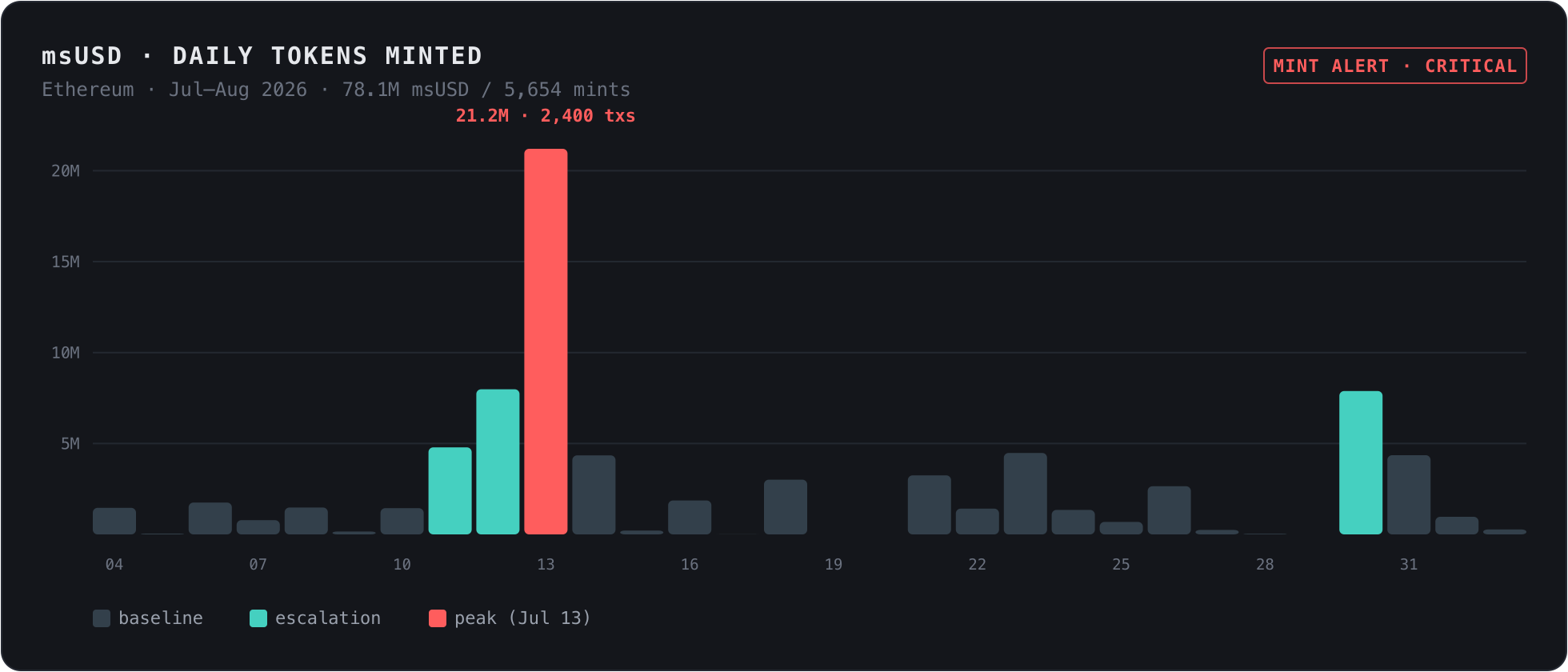
Our Peg Canary engine watches mint events and scores how fast they’re occurring against the token's own supply. For Metronome msUSD the month isn't subtle. It ticks along at a million or two a day, and then in the second week of July it goes vertical (Figure 1).
Over 30 days, msUSD minted 78.1 million new tokens on Ethereum across 5,654 transactions, roughly 2.8 times the ~27.7 million circulating on the chain at the time. (It also trades on four more chains, Base, Optimism and Plasma among them; fold those in and circulating supply is around 38.7 million tokens, a market cap near $28 million at the $0.73 consensus; the monitor's cross-chain figure reads about $32M, marked off a higher per-token price.) July 13 did a lot of the work by itself: 21.2 million tokens in 2,400 separate mints, more than a quarter of the whole month in a single day. Our supply-velocity signal flagged it critical.
One thing we're careful about here: fast minting on its own doesn't prove anything shady, and this wasn't a hack. We pulled the July 10 contract upgrade that preceded the mint surge, and it was a normal 3-of-5 multisig on a verified implementation, no sign of a stolen key. Metronome's own post-mortem, published July 30, names the real cause: Chainlink oracle latency. The ETH/USD feed sat outside its price band 18.5% of the time, and arbitrageurs kept minting synthetic assets against stale quotes faster than fees could defend, until the synthetic LPs were, in their words, "roughly 30% unbacked." Much of the minting we flagged was the treasury's own defense, looping synthetics into LP and AMO positions to hold the peg, which is why most of it landed in contracts rather than wallets. Either way, the measurement is the same: when a synthetic dollar's float outruns its backing, the market eventually charges the difference. It did. There’s a neat symmetry to it: the peg broke on a stale oracle inside Metronome’s own pricing, then hid behind a stale oracle in the market feeds. Two different feeds, same lesson. A single oracle you don’t cross-check is a liability, whether it’s mispricing your mints or masking your depeg.
Supply cuts both ways
Supply moves in two directions, and it's imperative to monitor both. StablR and USR earlier this year were expansion cases: private-key compromises that minted unbacked tokens into the market ahead of the break. Main Street's msUSD in June was the opposite, a contraction case, a multi-million-dollar redemption run that drained its reserves before the depeg. Metronome's msUSD refuses to pick a side. It blew up on the way in, and then, once confidence cracked, it started shrinking on the way out.
A depeg usually starts as a supply event; the price drop is the result. Watch only one direction and you miss half of them. A mint-only view lights up on July 13 and then goes quiet as issuance settles, and it never sees the exit. A redemption-only view sees nothing until people start running. We score both the same way: an unusual move in either direction, measured against the token's own supply, trips the signal.
Then the money ran
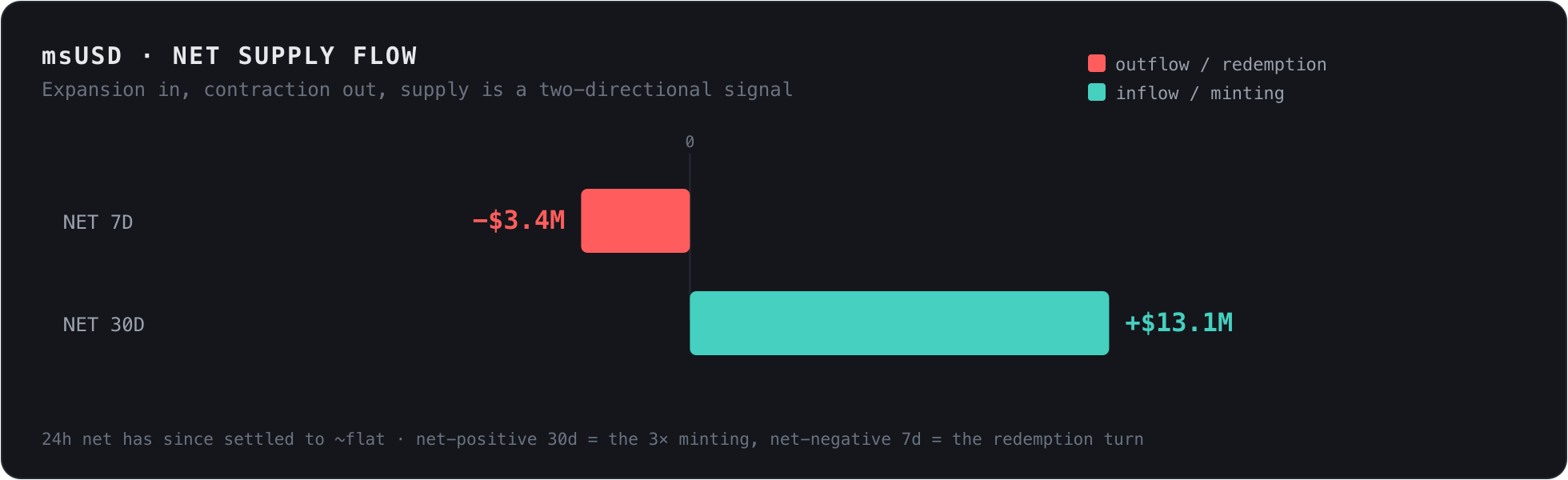
Once the peg visibly cracked, the flow flipped. Supply started leaving faster than it came in, the usual bank-run shape. The 24-hour number has since drifted back toward flat, but the 7-day window is still net redemptions, even while the 30-day total stays positive from all that earlier minting.
Exit Recs For Metronome Vaults
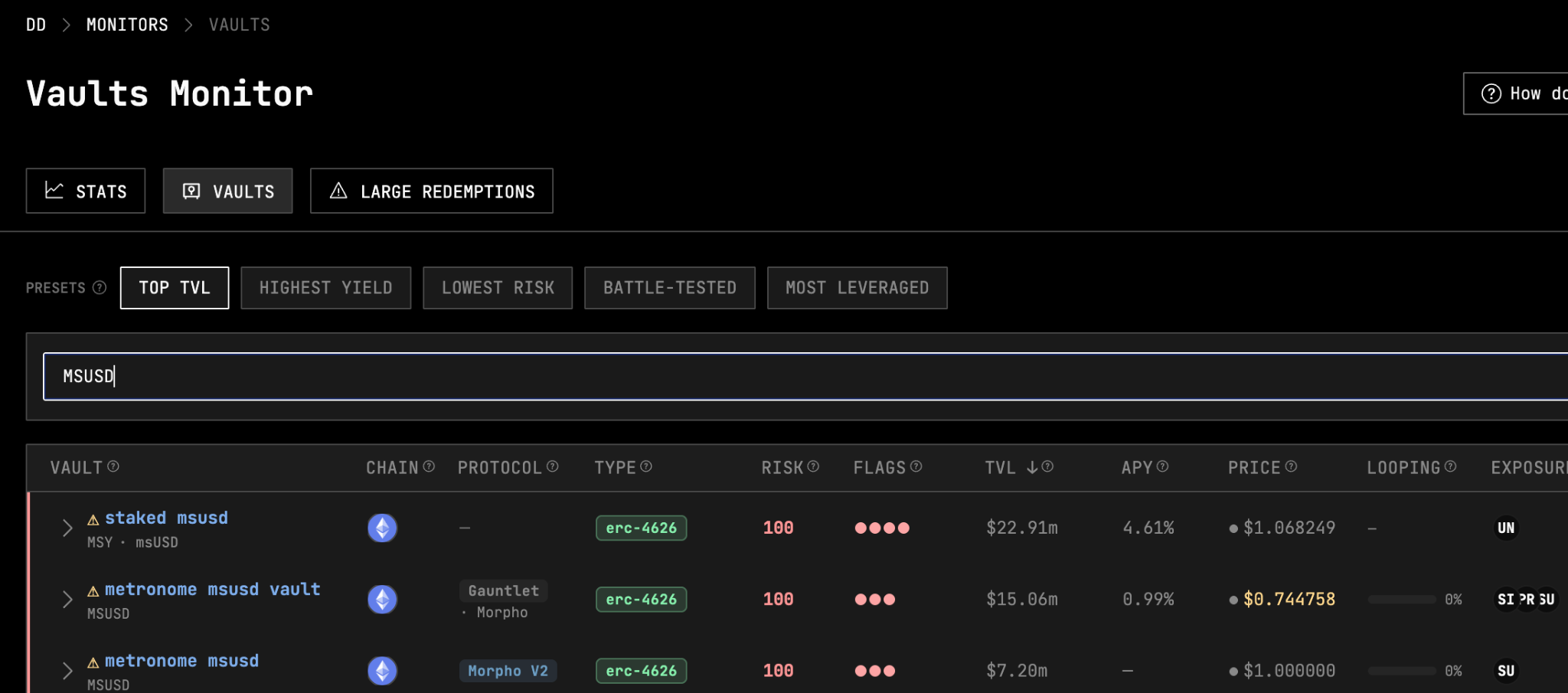
A stablecoin depeg rarely stays in the token, it leaks into other parts of the ecosystem like vaults holding it as collateral. Our vault risk engine was quick to analyze the depeg and give notice to Metronome vaults, both already flagged with EXIT recommendations.
Inside the Peg Canary Score
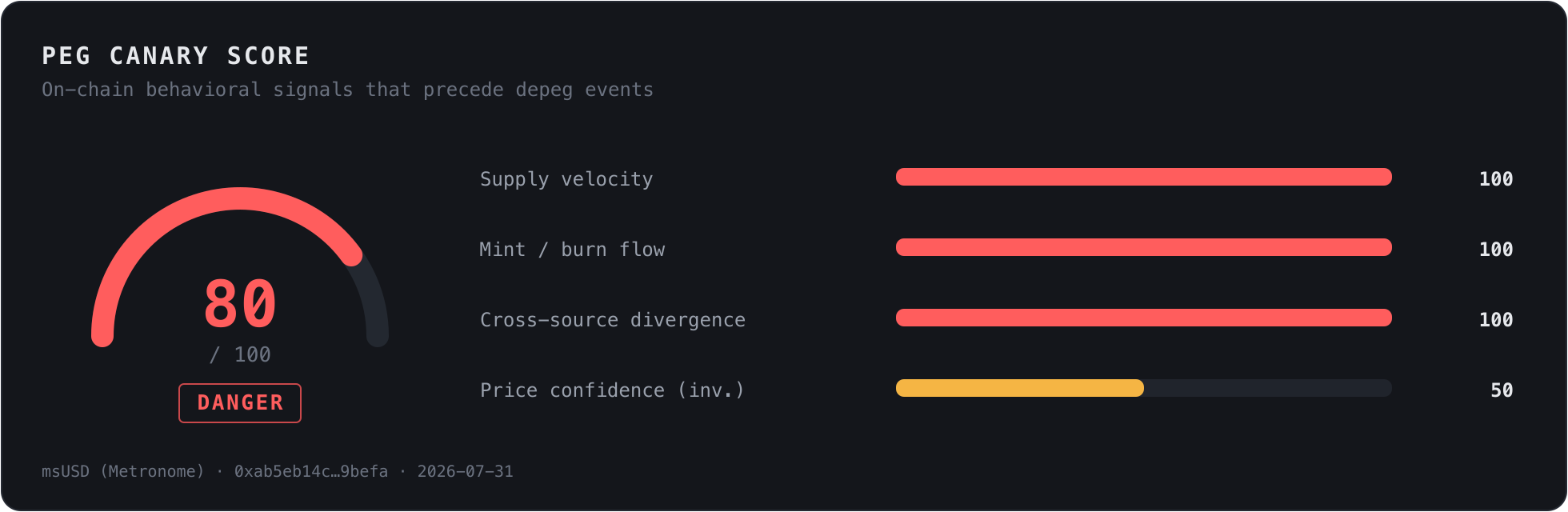
All of these signals roll up into one forward-looking number, the Peg Canary Score, meant to climb before a break finishes rather than confirm it after the fact. Metronome's msUSD is at 80/100, DANGER. And because it's built from parts, you can see exactly what's pushing it there.
How it played out
- Through mid-2026, the slow leak. Chainlink oracle latency let arbitrageurs mint synthetics against stale prices. The underbacking built quietly for over a year and accelerated through the first half of 2026, per Metronome’s post-mortem.
- Jul 04–10, baseline. Around 1 to 2M msUSD minted a day. Nothing that stands out on its own.
- Jul 10, proxy upgrade. Implementation swapped via a 3-of-5 multisig at 18:42 UTC. Verified, routine. Logged, not alarmed.
- Jul 11–13, the wall. Minting ramps 4.8M, then 8.0M, then 21.2M, that last day across 2,400 transactions. Supply velocity goes critical.
- mid-Jul, peg slips. Our multi-source read pulls away from the single-feed quote, and cross-source divergence pins at 100.
- late-Jul into Aug, redemptions and contagion. Net outflows on the week, two Morpho vaults ($22.3M) flagged EXIT, price $0.7326, down 26.7% from peg.
The pattern beneath all of them
One common thread among recent stablecoin depeggings: there's almost always an observable on-chain precursor before the price gives way. USR and StablR both showed abnormal mint velocity, unbacked supply pushed into the market, before the price broke. Main Street's msUSD held a flat oracle quote while net redemptions drained its reserves in the days before it depegged. Metronome's msUSD looked basically pegged on one feed while it minted close to three times its Ethereum float. Every time, the structural signals (backing, supply, redeemability, identity) moved first, and the price just ratified it later.
We build our depeg model around combining these structural signals and scoring them jointly: reconcile prices across sources by address, score supply in both directions against the token's own float, follow the exposure into the vaults that hold the collateral, and never let a shared ticker smear two different assets into one. On its own each signal is low-precision, noisy, and it fires often enough to be ignorable in isolation. The edge is in the combination: weighting a set of largely independent, multivariate signals into a single forward-looking score that crosses into alert territory before the price does. That's the bar we build to, and msUSD depeggings, in both of its flavors, is a decent argument for why.
Whether you're issuing a stablecoin, vault, or tokenized asset and want an independent view into emerging risks, or you're evaluating where to allocate capital and need continuous due diligence beyond a one-time audit, we'd love to talk. Our platform provides real-time structural risk analysis and monitoring designed to surface issues before they become market events. If you'd like to see how we can help, get in touch with the team.